





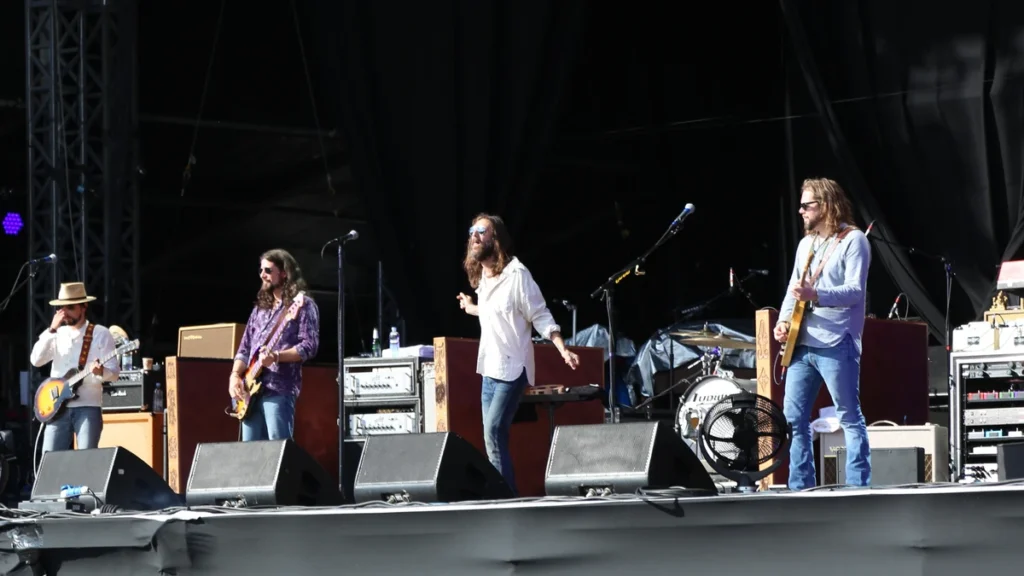
Between 2009 and 2024 the Black Crowes released no studio albums at all. They have now released two in two years.
A Pound of Feathers arrived on 13 March through Silver Arrow Records, the label the band owns, produced by Jay Joyce at Neon Cross in Nashville and running just under forty-two minutes.
Fifteen Years, One Breakup, Then a Rhythm
The gap is worth laying out because it makes the current pace remarkable. Before the Frost…Until the Freeze came in 2009. A covers and acoustic double album, Croweology, followed in 2010, then a twentieth-anniversary tour and a hiatus.
The band toured again in 2013, announced a breakup in 2015, and reformed in late 2019 to announce a tour. The ninth studio album, Happiness Bastards, did not appear until 2024.
That is fifteen years between studio records, punctuated by a formal split. Reunions of that kind normally settle into a touring business: play the catalogue, sell the tickets, and do not risk a new album that nobody asked for.
Two albums in two years is a different proposition entirely. It is the release rate of a working band, not a heritage act, and it is the first time since the early nineties that the Crowes have operated on that cycle.
Our piece on heritage acts and the farewell tour question covers the model this band has now stepped outside of.
The Question Chris Robinson Keeps Asking
Chris Robinson has described the thinking behind it plainly enough. “I’m always looking at the angle of, ‘Look, we’ve made a lot of records. We’ve been doing this a long time. What can we do with this one?'”
He continued: “It comes down to loving what you’re doing, and there’s joy in creation that we always get involved with and tap into…It forces you to be instinctual instead of thinking about it.”
The word doing the work there is “instinctual”. A band ten albums into a career has every reason to deliberate, and deliberation is what produces the careful, tasteful, slightly airless records that veteran acts usually make.
Making two albums close together is one way to prevent that. A short cycle does not leave room for a record to be reconsidered into blandness, which is a plausible reason to do it deliberately rather than because the songs were ready.
It also reframes what the fifteen-year gap was. Robinson’s account is not about material or inspiration; it is about whether the band was in a state to enjoy the work. That is a relationship problem, not a creative one, and the two brothers at the centre of it have spent decades demonstrating as much.
Their Own Label, and a Nashville Producer
Silver Arrow Records is owned by the band, which changes what an album release means. There is no label deciding whether a tenth Black Crowes record is commercially justified, no marketing plan to satisfy and no schedule imposed from outside.
That is the structural reason a band at this stage can put out two records in two years. Self-releasing removes the approval step, and the approval step is where most veteran albums quietly die.
The production choice points the other way. Jay Joyce is a Nashville producer with a track record across country and rock, and hiring him puts an outside ear on a self-released record — the one piece of external judgment the band chose to keep.
Neon Cross is Joyce’s own Nashville studio, so the band went to him rather than assembling something themselves. For a group with the means and the history to record anywhere, that is a decision to be produced rather than to self-produce.
The writing split is the traditional one: all lyrics by Chris Robinson, all music credited to Chris and Rich Robinson. Whatever else has changed across four decades, that arrangement has not.
A Band Without a Bass Player
The credits reveal something about how the record was made. Rich Robinson plays guitars, bass and backing vocals — one man covering both string roles.
Cully Symington is on drums, Erik Deutsch on keyboards, with Mackenzie Adams and Leslie Grant on backing vocals. There is no separate bassist listed at all.
For a band whose sound is built on interlocking guitar and a loose, rolling low end, having one player handle both parts produces a specific result. The bass follows the guitar’s phrasing because the same person wrote both, and the parts lock in a way two players have to work at.
It is also, practically, faster. A guitarist tracking his own bass parts removes a scheduling problem and a set of arguments, which matters on a record made to a short cycle.
The two backing vocalists are the other tell. Gospel-inflected backing has been part of this band’s sound since Shake Your Money Maker, and keeping it on the tenth album is a decision to sound like themselves rather than to modernise.
Eighty-Seven Out of a Hundred
The reception has been strong by any measure. The album holds 87 out of 100 at Metacritic and 7.6 at Any Decent Music, with four stars from AllMusic and Classic Pop and three from The Arts Desk.
An 87 is a high figure in absolute terms and an unusual one for a tenth album by a band formed in 1984. Records at that point in a career are typically reviewed with a kind of polite relief, and the scores cluster around respectable rather than excellent.
The spread is narrow too. Three-to-four stars across outlets with quite different priorities suggests broad agreement rather than one enthusiastic outlier pulling an average upward.
Two singles preceded it — a double A-side of “Profane Prophecy” and “Pharmacy Chronicles” on 9 January, then “It’s Like That” on 28 January — giving roughly two months of lead time before the March release.
Issuing a double A-side as the first release is an old-fashioned gesture, and on a self-released record it costs nothing but the decision. It also signals that the band had more than one song it wanted heard first, which is not the position most tenth albums are in.
What the Catalogue Says About This
The history gives the numbers their weight. The band formed in Atlanta in 1984, were signed to Def American in 1989 by George Drakoulias, and released Shake Your Money Maker the following year.
The Southern Harmony and Musical Companion topped the Billboard 200 in 1992. What came after — Amorica, Three Snakes and One Charm, By Your Side, Lions — sold moderately without approaching those first two records.
Then a hiatus from 2002 to 2005, a return, Warpaint reaching number five in 2008, and the long silence.
Read against that, the current run is the least likely phase of the whole career. A band with two enormous early records, a decade of diminishing returns, two hiatuses and a breakup has now produced its best-reviewed album in a very long time, on its own label, at a pace it has not managed since it was young.
Nobody needed a tenth Black Crowes album. That is precisely what makes it interesting that this one exists, and that it is good.
A Pound of Feathers is out now on Silver Arrow Records.
About The Author

More Stories
Matt Springfield: Poplife and Its Greg Haver Sessions, Reconsidered
How FYDStar Got Scream’s Cosmic Sludge Pop Out of a Bass and Drums Duo
Overcome by FISTFIGHT HXC, Reconsidered: Regina Hardcore with a Thrash Pulse