



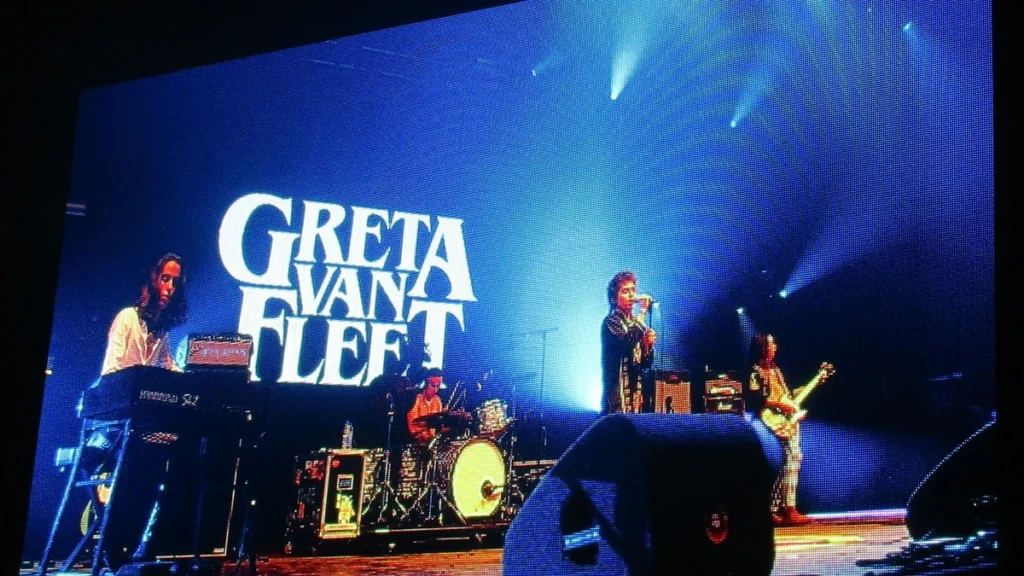
Greta Van Fleet headlined Alexandra Palace in London on their 2022 world tour. A friend explained where the building’s name came from, and four years later it is the title of their album.
Palace for the People is due on 9 October through Republic Records, recorded in Tennessee in the spring of 2026 and co-produced by the band with Mike Elizondo.
A Victorian Building Made for Everyone
The story behind the title is the most interesting thing about the announcement. Alexandra Palace — known in London as Ally Pally — was originally called The Palace of the People.
Unlike most elaborate Victorian buildings, it was not put up for monarchs or for wealthy aristocrats. It was built as a gathering place for the public, somewhere ordinary people could, in the band’s phrasing, escape and wonder.
Taking that as an album title is a claim about what a rock band is for. It positions the music as a shared public space rather than as a product, which is a fairly grand thing to assert and also a fairly traditional one.
The venue history gives it weight. Greta Van Fleet headlined Ally Pally on a sold-out 2022 world tour and went on to sell out Wembley Arena, so the reference is to a room they actually filled rather than to a piece of architecture they read about.
The album’s stated themes follow from it: humanity, connection, resilience and transcendence — a set of words that would be empty attached to almost any other title and which the building at least anchors.
The Producer Comes From Somewhere Else Entirely
Mike Elizondo’s credits are the detail that suggests the record is not a straight continuation. He has worked with Turnstile, Eminem and Fiona Apple — hardcore, rap and one of the most idiosyncratic songwriters in American music.
None of those is a blues-rock reference point, and that is presumably why he was hired. Greta Van Fleet have spent their career being compared to a specific 1970s lineage, and a producer with no investment in that lineage is unlikely to reinforce it.
Jake Kiszka has framed the record in exactly those terms. “As much as it is a Greta Van Fleet record and a rock and roll record at its core,” he said, “in its heart, it’s a very modern record.”
That is a careful sentence. It concedes the genre and the band’s identity, then claims something else on top — which is what a group in their position has to do if they want to move without losing the audience that arrived for the older sound.
Recording in Tennessee rather than Los Angeles or their native Michigan places the sessions in the middle of American roots-music geography, which pulls the other way. Our piece on heavy music’s festival economics covers the touring machinery a band this size operates inside.
Time Off the Road Made the Difference
The band’s own account of the record is about proximity rather than ambition. “We love each other just as much as ever, if not more, because we’ve got to spend quality time together off of the road,” the singer Josh Kiszka said. “We’ve grown closer, and we have more to say and share than ever.”
Drummer Danny Wagner put it more plainly: “The minute the four of us step into a room with the shared goal of creating, there is very little that can stop us.”
Those quotes describe a specific occupational problem. A band who tour arenas continuously spend enormous amounts of time in each other’s company without ever being in a room to write, which is a different kind of togetherness and a corrosive one.
Three of the four are family — Josh, Jake and Sam Kiszka are brothers, and Josh and Jake are identical twins — which makes the dynamic both more durable and harder to escape.
A band that formed in Frankenmuth, Michigan in 2012 and has been at arena level for most of the last decade has had very little unstructured time. Getting some appears to be what this record is built on.
The lineup has been fixed almost throughout, which is rarer than it sounds at this level. Josh, Jake and Sam Kiszka alongside Danny Wagner is the same four people who have made every record, with only one departure in the band’s history.
Continuity of that kind is what makes the time-off argument credible. A band with a rotating cast has a different reason for a gap between albums; a fixed four-piece taking a break is doing exactly what they said they were doing.
Two Singles, One Loud and One Not
The campaign has been deliberately split. “Play Your Games” arrived first and was described as an explosive return; “Saw You Stand”, released with the album announcement on 31 July, is a ballad.
Leading with a loud song and following it with a quiet one is the standard way to widen a record’s apparent range before anybody has heard it. It also hedges: listeners who wanted the riffs got them, and listeners who did not now know there is something else.
“Saw You Stand” has been described as equal parts intimate and cinematic, capturing the band at their most emotionally resonant — the language of a press release, but consistent with what a ballad from a band this size is for.
The announcement was timed to a rare sold-out show at Chicago’s Metro, a club rather than an arena. A band who fill rooms of fifteen thousand playing one that holds a thousand is a piece of theatre, and an effective one.
It also fits the title. An album named after a building constructed so the public could gather does not want to be introduced from a stage a quarter of a mile from the audience.
Where the Band Stands Now
Greta Van Fleet have been a working band since 2012, signed to Lava in March 2017 and now on Republic, with a Grammy already behind them.
Their position is unusual and slightly awkward. They arrived to enormous commercial success and immediate critical scepticism about how closely they resembled their influences, and the whole subsequent career has been a negotiation with that.
Hiring a producer from outside the tradition, recording in Tennessee, naming the album after a Victorian public hall and leading with a ballad are four separate answers to the same question.
Whether they add up will be clear in October. The premise, at least, is more interesting than a fourth record from a band in their position usually manages.
The genre labels attached to them — hard rock, blues rock, progressive rock — describe a band who have always been working in more than one register, which is easily lost under the comparisons. Progressive rock in particular sits awkwardly with the accusation of straight imitation.
A ten-week gap between announcement and release also gives the record room to be heard on its own terms. Two singles, one club show and no further campaign is close to the minimum a major label will accept, and it puts the weight on the album rather than the build-up.
For a band whose title refers to a place built so that everyone could get in, that restraint is at least consistent.
Palace for the People is out on 9 October through Republic Records.
About The Author


More Stories
The Sound of Marigny Studio and the Bayou on Rising by Jeb Rault
Swiss Dialect Rock, Reconsidered Through Zueri by Dave Curl
How Bite To Break Got the Weight of Slam and Death Metal Onto In My Head