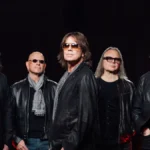

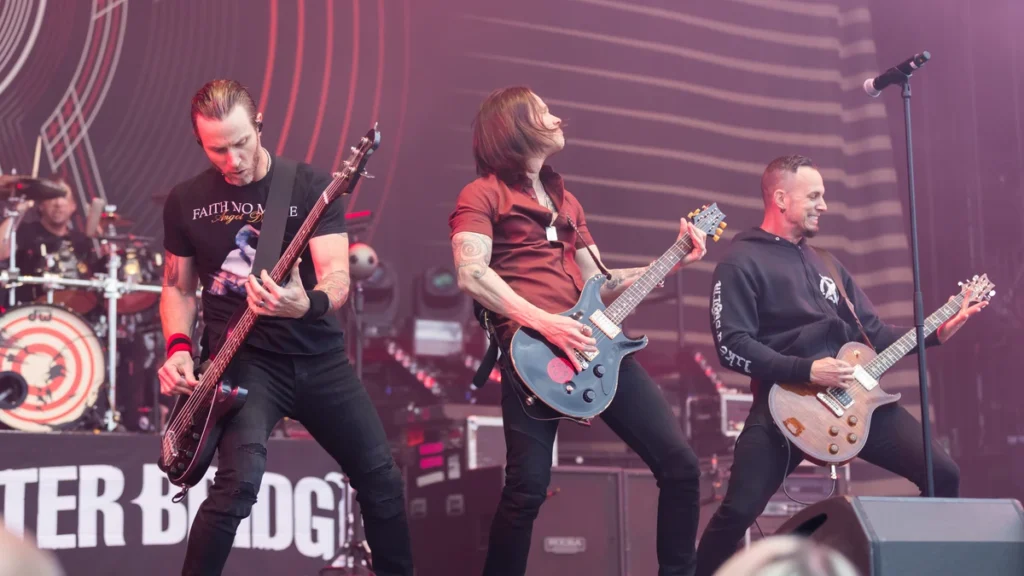
Every member of Alter Bridge has another job. Making the band’s eighth album was largely a question of finding a window when none of the other jobs needed them.
The self-titled record arrived on 9 January through Napalm Records, running sixty minutes and thirty-nine seconds, recorded across 2025 and produced by Michael “Elvis” Baskette.
The Scheduling Was the Hard Part
Myles Kennedy put it plainly. The band’s timeline was more complex this time, he said, with his bandmates enjoying the Creed reunion.
“It’s just a matter of when the record will be released, given everyone’s schedules,” he told an interviewer, adding that “with Alter Bridge, Slash, and his solo projects, everybody loves to work and there’s still drive to create and make music and tour”.
That is an unusually candid description of a structural problem. Alter Bridge is not a side project for anybody in it, but it is also not the only thing any of them do — Kennedy sings for Slash’s band and releases solo records, and the rhythm section and Tremonti have a reunited Creed occupying substantial time.
Bands in that position usually deteriorate. The album gets made in fragments, the members are never in the room together, and the result sounds assembled rather than played.
The reviews suggest that did not happen here, which points at how deliberately the window must have been protected. An album recorded across a single year, in two studios, by a band with three competing calendars, needed somebody to defend the dates.
They Recorded at Eddie Van Halen’s Studio
Where they did it is the other detail worth noting. Sessions took place at 5150 in Los Angeles — the studio Eddie Van Halen built at his home and named after the police code — alongside Studio Barbarosa in Orlando.
5150 is not a neutral choice for a hard rock band. It is where Van Halen made the records that defined a particular idea of American guitar playing, and booking it carries an implicit claim about the tradition you think you are in.
It is also, practically, a room designed around a guitarist. For a band with two guitar players and a producer who specialises in getting guitars to sit in a dense mix, that is a functional advantage rather than a symbolic one. Our piece on what a producer does on a heavy record covers the work Baskette would have been doing there.
Splitting the sessions between Los Angeles and Orlando fits the scheduling picture too. Orlando is home territory for the band, and a second studio close to where people live is how you record around commitments rather than in spite of them.
Self-Titled on Album Eight
A self-titled record almost always means one of two things. Either it is a debut, where the band’s name is the only thing there is to say, or it is a statement that a group has arrived at what it actually is.
Arriving eighth, it can only be the second. Mark Tremonti said in advance that the band were planning something “ridiculously cool” for album eight, and that it would be inspired by something “really, really special” — which is vague, but the naming decision is not.
The genre labels attached to the record support the reading. Reviewers have described it as hard rock, progressive rock and alternative metal at once, which is a fair description of a band who have spent two decades refusing to settle in one of those.
Sixty minutes is also long enough to make that case. It leaves room for the progressive material without crowding out the songs that work on radio, and a shorter record would have forced a choice between them.
There is a commercial reading available too, and it is less flattering. A self-titled album is the easiest possible entry point for a new listener, and a band whose members have spent two years in front of much larger audiences through other projects has a reason to make the front door obvious.
Both things can be true. The record can be the one where the band feel they arrived, and also the one most likely to catch somebody who has just discovered the guitarist through a reunion tour.
The Producer Who Has Been There Throughout
Michael “Elvis” Baskette is the other constant. He has been the band’s producer across the recent catalogue, and keeping him through a record made in fragments is the practical decision it looks like.
A producer who already knows how a band sounds does not need the first week of sessions to find out. When the sessions are being fitted around three other schedules, that saved week is not a convenience but a condition of the record existing.
It also puts the sonic continuity in one pair of hands. Material captured in Los Angeles and Orlando, months apart, has to sound like one album, and the person most able to guarantee that is somebody who has made several already.
Four Singles Across Four Months
The campaign ran from early autumn into release week. “Silent Divide” came on 3 September 2025, “What Lies Within” on 8 October, “Playing Aces” on 3 December and “Scales Are Falling” on 7 January, two days before the album.
Four singles is a lot for a rock record, and the spacing is even — roughly a month apart, then a two-day gap before release. That is a campaign designed to keep a band in front of an audience across the quiet end of the year rather than to build to a single moment.
The album itself had been announced much earlier, on 15 July 2025, alongside tour dates for 2026. Announcing an album and a tour together, six months ahead, is how a band with complicated diaries commits publicly to a window.
It also explains the long singles run. With the release date locked in July for January, there were five months to fill.
The Reviews Were Unusually Warm
The reception was strong across the specialist press: nine out of ten from Blabbermouth, nine out of ten from Distorted Sound, four and a half out of five from Spill, and four out of five from both Classic Rock and Kerrang!.
That is a narrow, high band of scores. Rock records this far into a career more often produce a split, with long-standing outlets generous and general critics indifferent, and the consistency here suggests the album did something specific rather than something safe.
It also arrives in a genre where an eighth album is normally a catalogue event rather than a news one. A band of this vintage is generally reviewed against their own back catalogue, and scores in this range mean the comparison went well.
The tour dates announced alongside the album in July 2025 are the practical test of that. A band can protect a recording window once; a touring cycle requires the same three calendars to stay clear for months at a time.
What the notices cannot answer is whether the arrangement holds. A band whose members are all in demand elsewhere can make one very good record in a protected window; doing it repeatedly is a different problem, and the next gap will be harder to find than this one was.
Alter Bridge is out now on Napalm Records.
About The Author

More Stories
Matt Springfield: Poplife and Its Greg Haver Sessions, Reconsidered
How FYDStar Got Scream’s Cosmic Sludge Pop Out of a Bass and Drums Duo
Overcome by FISTFIGHT HXC, Reconsidered: Regina Hardcore with a Thrash Pulse