





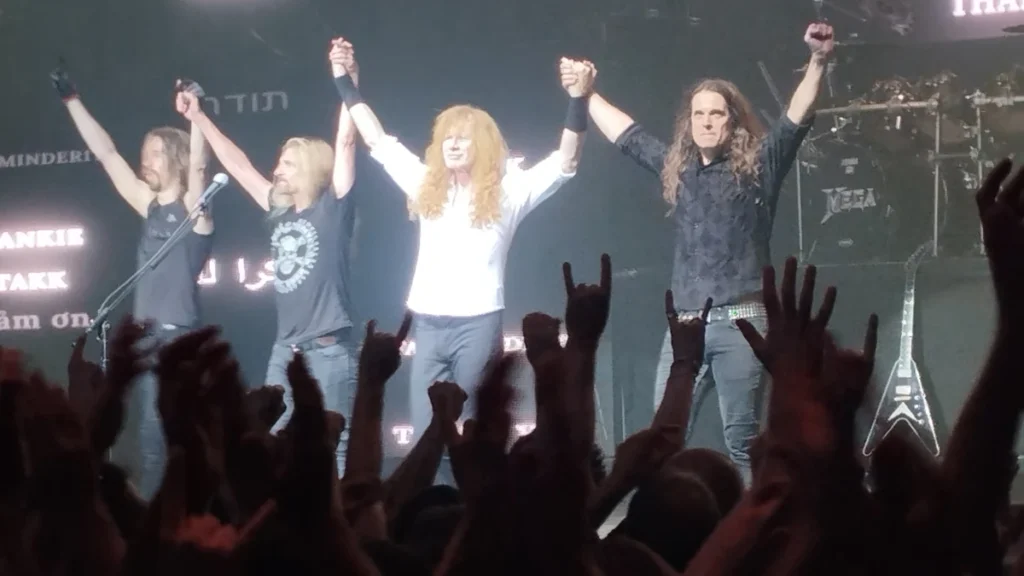
Megadeth have released seventeen studio albums since 1985 and sold more than fifty million records. Only one of them has reached number one on the Billboard 200, and it is the last one they will make.
The self-titled record, also known as the White Album, came out on 23 January through BLKIIBLK and Frontiers, running forty-seven minutes and thirteen seconds. It entered the chart at number one with 73,000 units.
Forty Years to the Top of the Chart
That figure deserves a moment. Seventy-three thousand units is a modest number by historical standards — a band at their commercial peak in the 1990s would have needed several times that to lead the chart — and it says as much about the current market as about Megadeth.
But the record still had to beat everything else released that week, and it did so after a career in which fifteen previous albums had not. Five of those went platinum; one won a Grammy for Best Metal Performance in 2017. None of them topped the chart.
The explanation is partly in how a farewell works. An announced final album converts a catalogue audience into a purchasing one in a single week, because there is no next time to wait for. Fans who would have streamed it bought it instead.
That is not a diminished achievement so much as a different one. It is a measure of how many people have stayed with the band for four decades, expressed in the only unit the chart understands.
They Said It Was the Last One From the Start
The album was announced on 14 August 2025 with a social media trailer featuring the band’s mascot Vic Rattlehead and a press release from Dave Mustaine. Both said plainly that the record would be the band’s last, and a farewell tour was announced to run through 2026.
Declaring a final album eighteen months in advance is a risk. It sets the reception before anybody has heard a note, and every review becomes a summary of a career rather than an assessment of a record.
It also removes any possibility of a quiet exit. A band that stops without announcing it can always reconvene; one that runs a farewell tour has made a public commitment it would look foolish to break.
The artwork committed to the same idea. Released before the album even had a title, it depicts a burning Vic Rattlehead — the mascot who has appeared on Megadeth covers since the beginning, set on fire.
The Line-Up That Made It
The band that recorded the final album is not the one most associated with it. This is the only Megadeth studio album featuring guitarist Teemu Mantysaari, and the first since 2009’s Endgame to include bassist James LoMenzo.
Mustaine produced it with Chris Rakestraw, and recording ran across 2024 and 2025 at One on One Recording in North Hollywood, NOZ Entertainment in Nashville and Hydeaway Studios in Los Angeles, with mastering at Sterling Sound in New Jersey.
The process began remotely. In December 2024, Mustaine posted that production was under way with Rakestraw while the rest of the band were away over the holidays, and that he and Mantysaari were working on new music at a distance, with everyone due to convene a couple of weeks after Christmas.
By June 2025 the album was near completion and Mustaine was posting videos of himself recording vocals. That is a fourteen-month cycle from first session to release, which is a normal working pace rather than a valedictory crawl.
Mustaine is the only constant across all seventeen albums — co-founder, frontman, primary songwriter and sole continuous member — and that fact sits underneath the decision to stop. A band with a rotating cast and one fixed centre ends when the centre decides it does, and there is nobody else with standing to carry the name forward.
It also explains why the final line-up looks the way it does. Recruiting a guitarist who will appear on exactly one album, and bringing back a bassist absent for fifteen years, are the choices of a bandleader assembling a closing configuration rather than building something meant to last.
Four Singles and a Slow Title Reveal
The campaign ran across four months. “Tipping Point” was announced on 25 September 2025 with a thirty-second video clip and released on 3 October, followed by “I Don’t Care” on 14 November, “Let There Be Shred” on 19 December and “Puppet Parade” on 19 January, four days before the album.
Between the first two singles, in October 2025, the band revealed the remaining song titles gradually across several days — a small, cheap piece of engagement that works only for an audience already paying close attention.
“Let There Be Shred” as a single title is worth noting for what it signals. A band on their last record could reasonably have reached for gravity; naming a song after the least solemn thing a thrash guitarist does suggests they declined to.
The chart result vindicated the sequencing. Our piece on the case against rock being dead covers what a heavy record at number one actually demonstrates about the format’s audience.
The Bonus Track That Closes a Loop
Ten main tracks were joined by two bonus recordings, and one of them is the most loaded thing on the album.
Megadeth covered Metallica’s “Ride the Lightning” — a song Mustaine co-wrote. He was Metallica’s lead guitarist from 1981 to 1983 and never appeared on one of their albums, but he holds writing credits on four songs from Kill ‘Em All and two from Ride the Lightning.
Recording one of those songs yourself, on your own final album, forty-three years after leaving the band that released it, is not a subtle gesture. It is also a reasonable one: he wrote it, and this is his last chance to put his own version on a record.
The second bonus track, “Bloodlust”, was available only on copies bought at Target. Mustaine described it in a video on the band’s YouTube channel as being about vampires — which, after everything else, is a pleasingly unpretentious note to end a discography on.
A retailer-exclusive track on a farewell album is a small commercial detail with a real consequence: a portion of the band’s last recorded work exists only for people who bought a physical copy in one American chain. Twenty years from now that will be the hard-to-find Megadeth song, which is presumably the point.
It is also a reminder that a final album is a product as well as a statement. Target exclusives, deluxe variants and retailer editions all exist to convert the same catalogue audience twice, and a farewell is the last opportunity to do it.
What a Farewell Album Is For
The reviews were mixed to positive, which is close to the standard outcome for a final record. A last album carries an impossible brief: it has to summarise a career, satisfy people who have listened for decades, and be good on its own terms.
Most bands in this position choose one of two routes. They either make a legacy record that revisits their signature sound, or they make something deliberately unlike anything they have done, on the grounds that there is nothing left to protect.
The evidence here points firmly at the first. A self-titled thrash album with the original mascot on the cover, produced by the frontman, containing a song called “Let There Be Shred”, is not a band experimenting on the way out.
There is a case that this is the correct choice. Forty-three years of listeners have a claim on a final record that a band’s own curiosity does not override, and giving them the record they came for is a defensible way to close.
The number one says they took it. Whatever else the album is, it is the first time in seventeen attempts that Megadeth led the chart, and they did it on the way out.
Megadeth is out now on BLKIIBLK and Frontiers.
About The Author





More Stories
Matt Springfield: Poplife and Its Greg Haver Sessions, Reconsidered
How FYDStar Got Scream’s Cosmic Sludge Pop Out of a Bass and Drums Duo
Overcome by FISTFIGHT HXC, Reconsidered: Regina Hardcore with a Thrash Pulse