


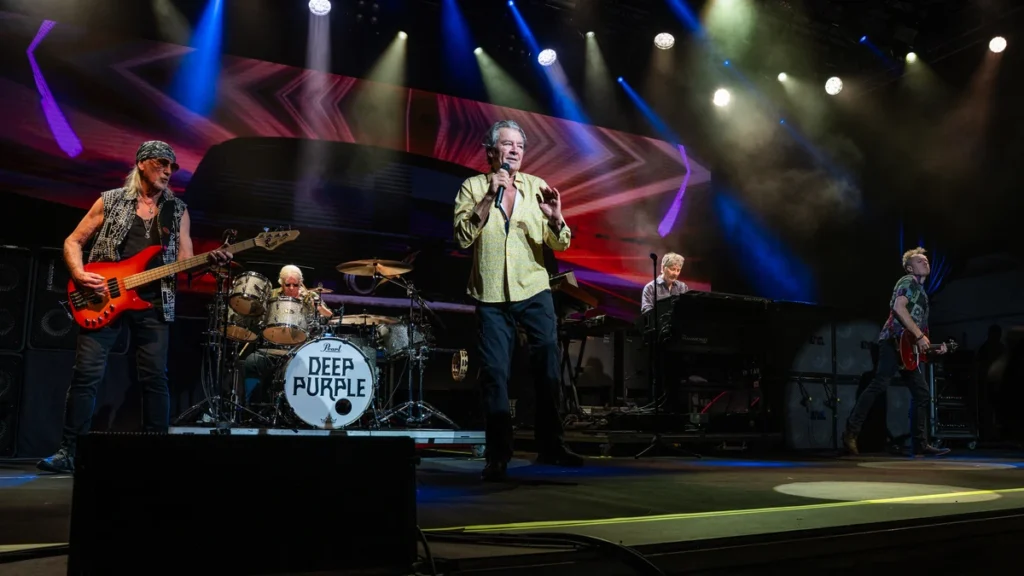
Bob Ezrin has produced every Deep Purple album since 2013 and helped write most of them. On the sixth record they have made together, his name appears in only one of those two places.
Splat! came out on 3 July through earMusic, running fifty minutes and twenty-four seconds. It is the band’s 24th studio album, and the first since 2005 that they wrote without anybody outside the group involved.
The Credit That Quietly Changed
All thirteen songs are credited to Don Airey, Ian Gillan, Roger Glover, Simon McBride and Ian Paice — the five current members, and nobody else. Ezrin produced, mixed, contributed additional arrangements and sang background vocals, but did not write.
On every previous album of the partnership, beginning with Now What?! in 2013, he had. Going back further, the last Deep Purple record written without additional input was Rapture of the Deep in 2005, which puts a twenty-one-year gap on either side of this decision.
Producers who write with the band they are producing hold an unusual amount of influence. They shape the material at its origin rather than arranging what arrives, and a band that has worked that way for a decade has, by definition, not tested what it sounds like alone.
Taking the credit back is therefore a larger statement than it looks in a liner note. It says the group believed they no longer needed the help — which is a confident thing to conclude on your 24th album rather than your fourth.
Keeping Ezrin in the chair while removing him from the songwriting is the part that makes it deliberate rather than circumstantial. Had the relationship simply ended, he would not be producing at all. The band changed one specific thing and left the rest intact.
The Second Album With a New Guitarist
Context matters here. Splat! is only the second Deep Purple album with Simon McBride, who joined for the band’s 2024 record =1 following Steve Morse’s departure.
A first album with a new guitarist is usually a settling-in exercise. The second is where the player either becomes part of the writing engine or stays a hired hand, and the credit list answers that question directly: McBride is one of the five names on every song.
That is a plausible reason for the change. A band that has just added a writing member has more internal material than it did, and less need for an external one.
McBride’s own summary of the record was that it sounded like a “freight train”, and the band have described it as the heaviest Deep Purple album in many years.
They Stopped Using Valve Amplifiers
The other first is technical, and for a band of this vintage genuinely surprising. Splat! is the first Deep Purple album recorded with amp modellers rather than tube amplifiers.
Valve amps are close to an article of faith in heritage hard rock. The argument for them is that they distort in a way digital modelling approximates rather than reproduces, and the argument against is that they are heavy, unreliable and impossible to record quietly.
For a band whose sound was defined in the era those amplifiers came from, abandoning them on album twenty-four is not a small choice. It also explains something about the record’s reported heaviness — modellers make it trivially easy to stack and reshape distorted guitar in ways a room full of valve amps does not.
Recording took place across four studios: The Sound in Nashville, Noble Street in Toronto, Headline Music in Harston and SMB Chameleon in Hamburg. Digital rigs travel; a wall of amplifiers does not, which is the practical version of the same point.
A Concept Album About the End of Everything
The album carries a loose concept, and Gillan has been careful about how it is described. Its lyrics explore an end-of-humanity idea, which he explains in the liner notes as “not in any crude apocalyptic sense but as a metamorphosis beyond physical existence”.
The clearest illustration is “Guilt Trippin'”, written as a conversation between God and Charles Darwin, each reflecting on the bleak fate of the world and which of them carries more of the blame. That is an unusually literary premise for a hard rock song, and it comes with a musical decision attached.
The track brings back Gillan’s original screaming vocal delivery, the style that defined the band’s Mark II period and which he has not used for a number of years. A singer in his eighth decade choosing to go back to that is a risk with a very public failure mode.
Three singles preceded the album: “Arrogant Boy” on 12 May, “Diablo” on 5 June and “Guilt Trippin'” on 23 June. Keith Urban plays guitar on “Diablo”, one of the few outside contributions on a record otherwise made by the five of them.
What the Reviews Made of It
The reception was solid rather than ecstatic: a Metacritic score of 79 from four critic scores, with four out of five from Classic Rock and Record Collector and seven out of ten from Clash.
Writing for Clash, Robin Murray opened by acknowledging the obvious: “This shouldn’t really be happening. Rock tends to be a young man’s game, but Deep Purple are — somehow — igniting competition with group’s almost a quarter of their age.” The members range from 78 to 80 years old.
His reading of the record is that it works by drawing on the band’s own history without simply repeating it. He heard the opener’s “chugging keys redolent of their early 70s salad days”, a riff on “Diablo” that “could turn the head of erstwhile Deep Purple guitarist Ritchie Blackmore”, and “The Lunatic” outdoing “their frenzied mid 70s cuts”.
He was not uncritical — “if the album can at times feel narrow”, he wrote, folk flourishes on “Sacred Land” provide relief — but his conclusion was unambiguous: “A remarkable torrent of energy from men old enough to be great-grandfathers, this is a supreme rock achievement.”
A 79 is a fair result for a record of this kind. Heritage albums are usually reviewed against a band’s own peak rather than against current releases, which is an impossible comparison, and scores in that range generally mean the record cleared the bar critics actually apply.
Why the Late Catalogue Keeps Coming
Deep Purple formed in London in 1968 and have been active, with one seven-year break, ever since. Twenty-four albums across that span is a working rate, not a legacy operation, and the last four have arrived at roughly three-year intervals.
That is the part worth noticing. A band of this standing has no commercial need to make new records — the catalogue and the live show sustain themselves, and new material typically reduces the number of familiar songs in a set rather than adding to it. Our piece on heritage acts and the farewell tour question covers the economics that usually push the other way.
What makes this one different is the combination of decisions inside it. A band could make a late-career album on autopilot, with the producer writing, the usual amplifiers and the singer staying inside his current range. This one changed all three at once.
None of those changes were forced. Ezrin was available and willing, the valve amps still work, and nobody was asking Gillan to scream. They are the choices of a group still treating each record as a thing to get right rather than a thing to deliver.
Whether it is genuinely their heaviest album in years is a matter for listeners with fifty years of comparison to draw on. What is not in doubt is that it is their most self-determined in twenty-one.
Splat! is out now on earMusic.
About The Author

More Stories
Matt Springfield: Poplife and Its Greg Haver Sessions, Reconsidered
How FYDStar Got Scream’s Cosmic Sludge Pop Out of a Bass and Drums Duo
Overcome by FISTFIGHT HXC, Reconsidered: Regina Hardcore with a Thrash Pulse