



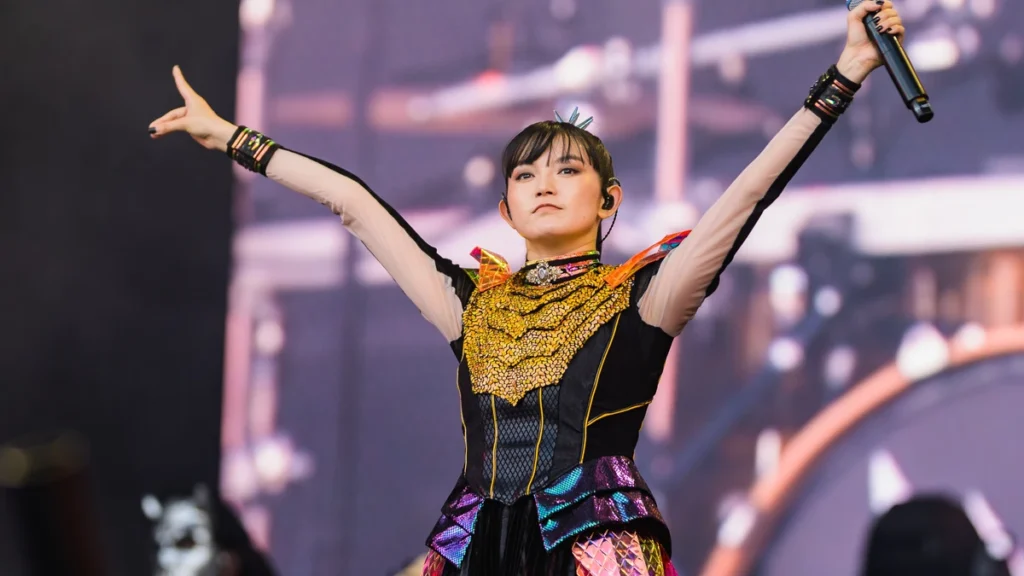
Babymetal performing at Tons of Rock in Oslo in 2026.
Babymetal open their North American headline dates in Denver on 2 September, before Latin American shows in November and December.
A deluxe edition of their most recent album arrived in June pressed as a zoetrope.
A Record That Animates
The vinyl edition uses a zoetrope design, which is a printed pattern on the disc that appears to move when the record spins.
The effect relies on a strobe or a camera shutter matching the rotation speed, at which point a sequence of still images on the surface reads as animation.
It is an old optical trick applied to a format that happens to rotate at a fixed speed, and it only works because vinyl turns at exactly 33 or 45 revolutions per minute.
Ten figures from the record are animated this way, which makes the object itself part of the release rather than a container for it.
Physical Formats as the Product
Effects of this kind exist because the physical market changed what a record is for.
Nobody buys vinyl to hear music they could stream instantly at higher fidelity, so the object has to justify itself on other grounds.
Picture discs, coloured pressings and animated surfaces are all answers to the same question, and the zoetrope is among the few that does something a download cannot.
Opening in Denver
The headline run begins on 2 September in Denver, which is a common opening city for American tours.
It sits between the coasts, has a reliable metal audience, and its altitude makes it a genuinely difficult first night for any band that has just flown in.
Starting there rather than in a coastal market means the production is worked up before the largest crowds see it.
Two Festivals in the Routing
The run includes a Louisville festival on 19 September and a Sacramento one on 3 October.
Those are two of the largest hard rock and metal festivals in the United States, and together they anchor the American autumn circuit.
A tour routed around both is being built to reach the festival audience as well as the ticket-buying one, which are overlapping rather than identical groups.
Two Support Acts
An American hard rock band and a newer act share the support slots across the North American dates.
Pairing an established rock act with an emerging one is the standard three-band construction, and it broadens the bill without diluting it.
It also produces an evening where three different ideas of what heavy music sounds like are presented in sequence.
South America in November
Latin American dates follow across Sao Paulo, Buenos Aires, Santiago, Lima and Mexico City.
South America has one of the most demonstrative metal audiences anywhere, and bands who tour there consistently describe it as unlike anything in Europe or North America.
It is also expensive and logistically difficult, which is why the dates are frequently promised and less frequently played.
Reaching Five Countries in Two Months
Routing a Latin American leg means long flights between cities rather than drives, with equipment moving separately and customs at every border.
That is why these legs are short, dense and usually limited to capital cities, since a secondary market cannot absorb the cost of getting the production there.
Five countries in a few weeks is a substantial commitment for a band whose home market is on the other side of the world.
A Japanese Act on an American Circuit
The group’s position is unusual: a Japanese band headlining American metal venues, with American acts supporting.
Very few Japanese artists in any genre have built that kind of footprint, and the ones who have generally did it through a specific subculture rather than through general popularity.
What made it possible here was the internet rather than radio, which is a distinction worth keeping in mind about the whole career.
The Form They Invented
The combination the band works in had no real precedent, which is the reason it drew so much attention.
It fuses the vocal and choreographic conventions of Japanese idol pop with the arrangements, tempos and instrumentation of metal, played by a full band.
Neither audience was expected to accept it, and the initial reaction from both was substantially hostile before it was not.
Why the Hostility Faded
The objection from metal audiences was that the format was manufactured, which is a charge with a long history in that genre and a poor record.
What changed most minds was the playing. The touring band is made up of session musicians of a standard that makes the technical argument difficult to sustain.
Metal has always been more open to novelty than its reputation suggests, provided the musicianship holds up.
A Major Label Deal
The deluxe edition came through a major label, which is a position very few metal acts occupy.
Majors largely exited heavy music decades ago, leaving it to independents that understood the audience better and needed smaller numbers to break even.
An act that sells across territories and formats is one of the few propositions that still fits a major’s model, which explains the arrangement.
Announcing on a Fixed Date
The tour was announced around the band’s own annual observance rather than on a conventional press schedule.
Building a fixed date into the calendar and using it to make announcements is a small piece of fan-culture engineering that works well.
It creates a predictable moment of attention every year without requiring anything to have happened, which is more than most marketing achieves.
Costume and the Metal Audience
The visual presentation is a substantial part of the act and is closer to theatre than to standard metal staging.
Heavy music has a long tradition of costume, from corpse paint to full character personas, so the objection was never really to theatricality itself.
It was to the specific tradition being borrowed from, which is a different and less defensible complaint.
How a Zoetrope Record Actually Works
The technique is worth explaining properly, because most descriptions of it are wrong.
A sequence of slightly different images is printed in a ring around the disc. When the record turns, each image passes a fixed point in succession, and if the eye receives only one image per rotation step, the brain reads the sequence as movement.
That requires interrupting continuous vision, which is why a strobe light or a phone camera is needed. Under ordinary light the disc simply looks like a printed pattern spinning.
The images must also be spaced to match the rotation speed exactly, which means a design cut for 33 revolutions per minute will not animate correctly at 45. It is a genuine piece of engineering rather than a decoration.
What a Support Slot on This Tour Is Worth
The three-act bill is more consequential for the openers than for the headliner, and the reasons are specific to this genre.
Metal audiences arrive early. Unlike most touring formats, where the room fills during the second support act, metal crowds are in place for the first band, which makes an opening slot genuinely valuable rather than nominal.
The audience is also unusually loyal to discoveries. A band that wins over a metal crowd tends to keep them for years, which is why so many careers in this genre were built entirely from support tours.
For an emerging act, twenty nights in front of a headline metal audience is worth more than any amount of playlist placement.
What Is Actually Being Tested
Two things. Whether a two-continent run of that length can be sustained by a band whose show depends on precise choreography as much as on playing.
And whether an animated vinyl edition sells a record to people who already own it, which is the entire commercial theory behind the deluxe format.
One opening night in Denver, two American festivals, five Latin American cities, and a record that moves when it spins.
About The Author


More Stories
Matt Springfield: Poplife and Its Greg Haver Sessions, Reconsidered
How FYDStar Got Scream’s Cosmic Sludge Pop Out of a Bass and Drums Duo
Overcome by FISTFIGHT HXC, Reconsidered: Regina Hardcore with a Thrash Pulse