






A Winterthur Songwriter Sets Swiss-German Verses Against an English Chorus on a 2026 Single
A thumping beat, warm overdriven guitars and a verse sung in Zurich dialect: that is how Dave Curl opens Zueri. He released the single on 18 February 2026, and then the chorus arrives in English. That switch is the whole story of the record. It places a three-and-a-half-minute alternative rock song inside an older Swiss question: which language should rock use?
Dave Curl’s Zueri is in the playlist below, and his coverage across our desks sits on his artist profile. The single reached this desk through PopHits.Co Music Charts, which verifies independent artists and places their releases across its network of music news titles. Press play, then read on for the Swiss rock story behind it.


The Swiss Dialect Wave That Polo Hofer Started and Patent Ochsner Carried Into the Charts
Swiss rock has always had two camps. One sings in the language people speak at home. The other sings in English and looks abroad.
The first camp has a name. Mundartrock is rock sung in a German dialect. In Switzerland it took off in the 1970s and 1980s as part of a wider dialect wave. Polo Hofer was its pioneer. In 1971 he co-founded the dialect band Rumpelstilz, whose 1976 hits Kiosk and Teddybär used Bernese German. He did much to make Swiss-German rock and pop popular, and he earned the nickname Polo National during his lifetime.
The bands that followed turned that wave into a mainstream habit. Patent Ochsner, from Bern, sing in Swiss German. All of their studio albums but one have topped the Swiss charts. Gölä, who grew up near Thun, built a career singing mainly in Bernese German, but also in English.
The second camp, however, is the heavy one, and it is the one most rock fans abroad know. Krokus formed in Solothurn in 1975 and became popular in North America during the 1980s. Gotthard, founded in Lugano, chose English as well. Their last sixteen albums have all reached number one in the Swiss album chart. Both built their success at home without dialect.
So the language a Swiss rock song chooses is never neutral. It tells you who the song is for.

Where Dave Curl Fits, as Zueri Sets Zurich Dialect Verses Against an English Chorus
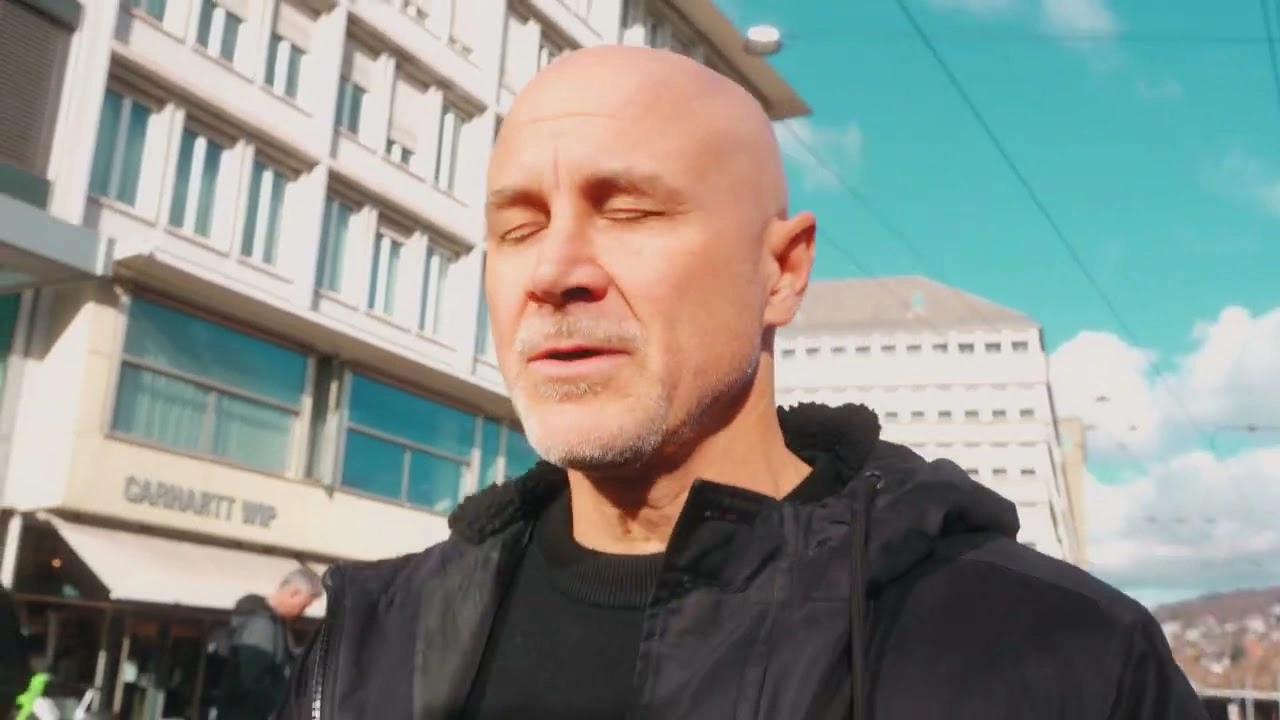
Dave Curl was born and raised in Switzerland, of English-Australian descent, and he works out of Winterthur. For more than twenty years he has written and sung his own songs, between folk, pop and a measure of rock. That background explains the shape of Zueri better than any genre tag.
The song is old. The first draft of the lyric dates from 1996. Rock Era Magazine reported that Curl began it as a student in the city, after a scene he saw beside one of its more affluent streets. It then took three decades to reach a finished recording.
The verses stay local. In Zurich dialect, Curl describes a man in old jeans singing to himself like a hungry animal. Businessmen with mobile phones sit in their cars as if in a bungalow and drive slowly past him. Illustrate Magazine placed the scene near Bahnhofstrasse, where an elderly man busked for coins beside the street’s luxury.
Then the chorus turns to English: Two sides to my heart, one wants to give / Oh, the other likes to take, and the old man sings along. The verses tell you where you are. The chorus makes the point for anyone, anywhere. That is the job English has done for Swiss rock since the 1970s.
The Studio Band, the Production and the Video
The recording backs that up. Curl cut the song with his studio band. Mathias Lunde drives it on guitars, Antonio D’Amato anchors the bass and Dario Scotti keeps it moving on drums. The production comes from ko-recording-arts in Germany. Illustrate Magazine heard catchy, thumping beats and gritty, melodic riffs. Rock Era Magazine, for its part, singled out the warm, overdriven guitars and a song that never settles. Meanwhile the official video takes the camera into the city streets, setting polished European frontages against graffitied alleys.

The Adjacent Acts, From Bernese Dialect Rock to Swiss Hard Rock Sung in English
The nearest neighbours are the dialect bands. Patent Ochsner show how far Swiss-German lyrics can travel inside the country. Gölä, in turn, shows the same two-language habit Curl uses, only spread across a career rather than inside one song.
On the heavy side, Krokus and Gotthard are the proof that English opens doors outside Switzerland. Zueri borrows that logic for its chorus while keeping its verses at street level in Zurich.
Curl’s own catalogue has moved quickly around this single. Since 2024 he has released Running Wild, Riders, Fool in Love, Casual Business Workspace and Empty as singles. He has also played more than 300 concerts, solo and with a band, from sofa shows to summer festivals. He does it alongside his work as a middle school teacher.
RockRevival.News’s curator team: “Zueri is built on a simple riff and a steady beat, and it does not need more. The dialect verses carry the street and the English chorus carries the argument. The guitars keep it moving for three and a half minutes.”
Where to Hear Zueri and Follow Dave Curl
Follow Dave Curl across platforms: Spotify, Apple Music, Deezer, SoundCloud, YouTube, Instagram, TikTok, Facebook and the official site.














About The Author





More Stories
How Bite To Break Got the Weight of Slam and Death Metal Onto In My Head
The Bowie Cover Def Leppard Played Before Every Show Is Now a Single
The Sound of Burlington Rock-Blues: Off the Tracks by Brian Leduke