





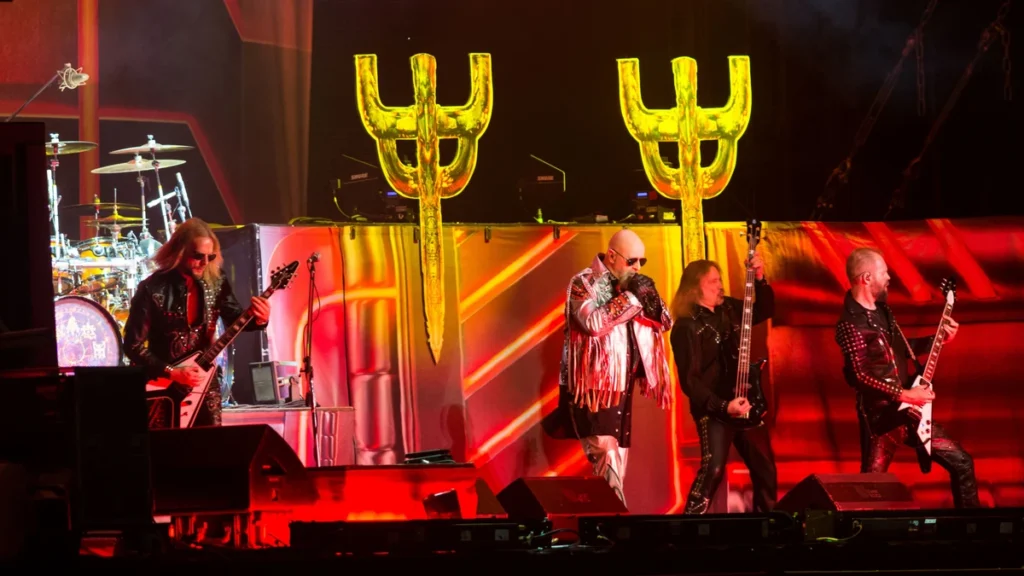
Judas Priest performing at Wacken Open Air.
Judas Priest intend to record a twentieth studio album this year, fitted around a European tour that runs from July into the autumn.
The last one arrived in 2024.
Twenty Albums Is an Unusual Number
Very few bands in any genre reach twenty studio albums, and almost none of those still tour at this scale.
The arithmetic is straightforward and brutal: twenty records at an average of three years apart is sixty years of continuous activity, which exceeds most working lives.
Reaching it requires not just longevity but a refusal to become a catalogue act, since the easier path is to stop recording and tour the hits indefinitely.
What makes it possible is usually a small number of people who never stopped writing, regardless of whether anybody was asking for new material.
Recording Between Tour Legs
Fitting a record around a festival summer and an autumn headline run is a specific way of working.
The alternative, blocking out six clear months, is what bands did when album cycles were three years long and touring was the promotion rather than the business.
Now the touring is the business, and albums get made in the gaps, which produces records assembled in pieces rather than written continuously.
The Cost of Making Records in Fragments
Working this way has a real effect on the result, and musicians are generally candid about it.
Songs written in a two-week gap between legs tend to be self-contained, because there is no time to develop an idea across sessions or to notice what the record is becoming.
The compensating advantage is that a band coming off a tour plays better than one that has been off the road for a year, which is audible in the performances even when the writing suffers.
Opening at a German Festival
The tour opens on 25 July at a festival in Monchengladbach rather than on a headline date.
Starting a tour at a festival is efficient and awkward at once: the fee is guaranteed and the audience is large, but the set is shortened and the production is whatever fits the shared stage.
It also means the first show of the cycle is played in front of a crowd that did not specifically choose to be there.
Germany as the Home Market
The routing is weighted heavily toward Germany, which has been this band’s most reliable territory for four decades.
German heavy music audiences are large, geographically distributed and unusually loyal to acts from the genre’s first generation.
For a British band, Germany has frequently been more commercially important than Britain, which is true across a great deal of heavy music.
Festivals First, Headlines Later
The structure runs festival appearances through the summer and a headline run from September.
That sequencing is standard and financially sensible. Festivals pay well and reach people who have not bought a ticket; the autumn headline dates then sell to the ones who were converted.
It also spreads the production cost, since the full staging only travels for the second half.
Central Europe on the Routing
The dates include Poland, the Czech Republic and Slovakia alongside the western European markets.
Central Europe has become a substantial and under-served market for heavy music, with audiences that reliably fill arenas for acts that make the trip.
Bands that established themselves there early hold those audiences for decades, which is a pattern visible across the genre.
The Album Before This One
The most recent record arrived in 2024 and was well received, which matters for what comes next.
A late-career album that lands well makes the following one considerably easier to justify, both to a label and to the band itself.
The opposite is also true, and it is the usual reason bands quietly stop recording without ever announcing it.
Twin Guitars as an Invention
The band’s most durable contribution is architectural rather than commercial.
Two lead guitarists playing harmonised lines and trading solos was not standard when they established it, and it became the default configuration for heavy metal within a decade.
Almost every band in the genre since has used some version of that arrangement, frequently without knowing where it came from.
The Visual Template
They also supplied the genre’s visual language, and that history is more specific than it is usually told.
The leather and studs the band adopted in the late 1970s came from subcultural clothing rather than from rock, and it was appropriated wholesale by a genre that largely did not know its origins.
Fifty years later it remains the default costume for heavy music, which is a remarkable durability for what was originally one performer’s decision.
One Continuous Member
The bassist is the only member present throughout the band’s entire history, which makes his account of the plans the authoritative one.
Bands with one continuous member occupy an odd position, since the institutional memory and the legal continuity sit with somebody who is rarely the public face.
It also means decisions about whether to continue eventually rest with a single person, whatever the billing suggests.
A Documentary at Fifty
A feature documentary covering the band’s five decades screened at a Toronto festival earlier this year.
Career documentaries are now a standard component of a heritage act’s business, and the good ones are made while the participants can still be interviewed.
That is not a morbid observation so much as a practical one, and it explains the sudden proliferation of these films across the genre.
Birmingham and What It Produced
The band came out of the same industrial English city as several of the acts that defined heavy music in the same few years.
The standard explanation involves factory work, industrial noise and limited alternatives, which is partly romanticism and partly accurate.
What is verifiable is the concentration: an improbable number of the genre’s founding bands came from a handful of square miles.
Why Late-Career Albums Get Made
The commercial case for a twentieth album from a band of this vintage is weak, and it is worth being honest about that.
It will sell a fraction of the catalogue, receive limited radio, and contribute perhaps two songs to a live set that already runs long.
The actual reasons are different and better. A band that records remains a band rather than a touring entity, and the alternative is a slow conversion into a tribute act performing its own material.
There is also a straightforward artistic one, which musicians state more plainly than journalists tend to report it: they still write songs, and songs that are never recorded do not exist.
What Fifty Years Does to a Set List
A catalogue of nineteen albums creates a problem that no amount of planning fully solves.
A two-hour set holds perhaps twenty songs. Nineteen albums contain roughly two hundred, of which forty or fifty have a genuine claim on the set, which means most of the catalogue is permanently unplayed.
Adding new material makes it worse, since every new song displaces one an audience has waited to hear, and the audience notices which.
The workable approaches are rotation across a tour or a deliberate exclusion rule, and both annoy somebody. There is no version where everybody hears what they came for.
What Is Actually Being Tested
Two things. Whether a record assembled in the gaps between tour legs can hold together as an album rather than as a collection of separately written songs.
And whether a twentieth album from a band this established finds an audience beyond the people who would have bought it regardless.
Nineteen albums behind them, a twentieth planned, a German festival in July, and a headline run from September.
About The Author





More Stories
The Sound of Burlington Rock-Blues: Off the Tracks by Brian Leduke
Matt Springfield: Poplife and Its Greg Haver Sessions, Reconsidered
How FYDStar Got Scream’s Cosmic Sludge Pop Out of a Bass and Drums Duo