





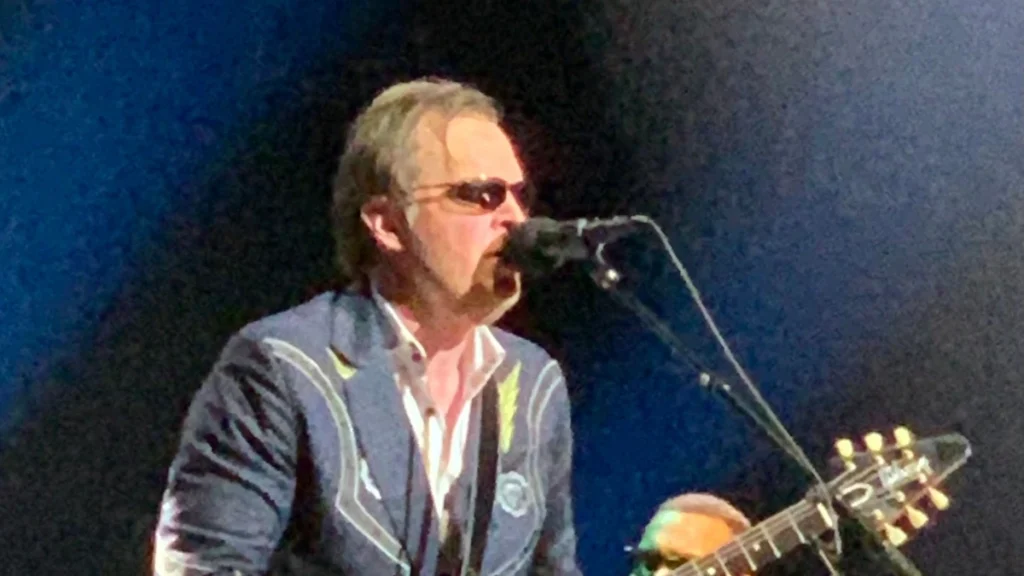
Joe Bonamassa performing in Milwaukee.
Joe Bonamassa spent six months releasing a thirty-two track tribute to B.B. King one volume at a time, completing it in February.
It was made with the King estate to mark a hundred years since his birth.
Releasing an Album in Instalments
Serialising a record across monthly volumes is unusual and it solves a specific problem.
A thirty-two track album released at once is close to unlistenable as an event. Most listeners take the first four songs, form an opinion, and never return to the second half.
Breaking it into monthly parts gives each batch its own moment, its own coverage and its own streaming placement, which a single enormous release cannot generate.
It also spreads the promotional effort across half a year rather than concentrating it into one week.
Why Long Albums Fail
The problem with a very long record is attention rather than quality.
Streaming platforms measure completion, and a record nobody finishes performs worse in the systems that determine what gets recommended.
Serialisation sidesteps that by presenting the work as a sequence of normal-length releases, which is a structural answer rather than a musical one.
Working With an Estate
The project was made in cooperation with the B.B. King estate, which is a specific and frequently difficult arrangement.
Estates control recordings, likeness, name and frequently unreleased material, and they vary enormously in how they exercise that control.
A collaborative project rather than a licensed one means the estate had approval over what was made, which constrains the work and legitimises it in equal measure.
Centennials as an Occasion
A hundred years since a musician’s birth is now a standard trigger for archival and tribute projects.
The reason is practical: an anniversary provides a commercial justification for work that would otherwise be difficult to fund or to place.
It also concentrates attention. Records like this released in an ordinary year attract a fraction of the coverage.
Why B.B. King Specifically
King’s importance to this genre is difficult to overstate and is frequently reduced to a single technique.
He established a vocabulary in which the guitar answers the voice rather than accompanying it, using space and a distinctive vibrato instead of density.
Almost every blues-derived rock guitarist since has worked inside that vocabulary, including ones who would not describe themselves as blues players.
Tribute Albums and Their Reputation
The format has a poor reputation and it is largely deserved.
Most tribute records are assembled from whoever was available, recorded separately, and sequenced without regard for whether the whole thing coheres.
What separates the exceptions is usually a single organising musician who plays throughout, which gives the collection a consistent voice underneath the rotating guests.
Contributors Across Generations
The project draws on musicians from several generations rather than concentrating on contemporaries.
That is the more interesting construction, since it demonstrates transmission rather than commemoration.
It also produces a record that argues the material is still being used rather than simply remembered.
His Own Album
Separately, his seventeenth studio album was recorded across sessions in Greece, Egypt, Nashville and Los Angeles.
Recording in four locations across three continents is expensive and produces a specific result: songs that carry the room they were made in.
It is also a working method available only to artists whose touring pays for it, which is worth noting about a genre with very little label money in it.
A Nomination That Did Not Convert
The album was nominated for best contemporary blues album at the 68th ceremony, where the category went to Robert Randolph.
Randolph’s win was a first after six previous nominations, which is its own long story.
Blues categories are among the smallest at the ceremony and the competition is correspondingly concentrated, with the same names recurring across years.
Eighteen Dates in a Month
The spring tour ran eighteen dates from 21 February to 21 March, through theatres and arenas in the Midwest and East.
Eighteen shows in a month is a dense schedule and it is only possible because the routing is tight, with short drives between markets.
Theatre touring at that rate is the economic engine of this genre, since blues-rock does not sell stadiums and does reliably sell two thousand seats.
Amphitheatres in the Summer
The summer leg moves to amphitheatres and festivals, with several acts sharing bills on selected dates.
Outdoor sheds are a different proposition from theatres: larger, less acoustically forgiving, and dependent on a package bill to fill.
Co-headlining with a band from an adjacent tradition is the standard way to make those rooms work.
A Genre Sustained by Touring
Blues-rock has almost no radio presence and modest streaming numbers, and it supports a substantial number of working musicians.
The explanation is entirely live. The audience attends repeatedly, buys physical media at the show, and follows individual players rather than the genre.
That produces a business with a low ceiling and an unusually solid floor, which is close to the inverse of pop.
Guitar Culture as an Audience
A significant part of this audience plays guitar, which changes what a performance has to deliver.
Players attend to hear specific things: tone, phrasing, the equipment being used, and whether the solos are the recorded ones.
It is a demanding audience and a durable one, and it explains why guitar-led genres sustain touring careers long after their commercial moment.
What a Serialised Release Actually Costs
The instalment approach has downsides that its advocates rarely mention.
An album released across six months is never experienced as a single work by anybody except the people who wait for the complete edition, which is a small minority of listeners.
Sequencing becomes largely theoretical. The order of tracks within a volume matters, but the shape of the whole thirty-two track collection is invisible to anyone who heard it as it arrived.
It also demands sustained attention from an audience over half a year, and the risk is that the later volumes land into diminishing interest rather than building momentum.
What Estates Get Right and Wrong
Posthumous projects are now a substantial part of the music business, and the outcomes vary enormously by how the estate operates.
The failures are familiar: unreleased material issued because it exists rather than because it is good, holograms, and licensing that places a name on work the artist had no part in.
The successes generally involve an estate that says no frequently, and a collaborating musician who knew the source material well enough to be trusted with it.
A centennial project built around one guitarist’s playing, rather than around archival recordings, at least avoids the worst version of the problem, since nothing is being presented as the dead artist’s own work.
Recording an Album in Four Countries
Splitting sessions across Greece, Egypt, Nashville and Los Angeles is a working method with real consequences, not just an interesting line in a press release.
Every room has a sound, and it is not a mystical claim. Ceiling height, wall material and floor surface determine how long a note takes to decay, which changes how a drummer hits and how a guitarist phrases. Musicians adjust to a room within about an hour without noticing they are doing it.
Recording in four of them produces songs that do not sound like they came from the same place, which is either incoherence or variety depending on how the record is sequenced and mixed.
The usual solution is to record the rhythm tracks in one location and the overdubs elsewhere, which keeps the foundation consistent. An album genuinely tracked in four countries is a harder proposition and a more interesting one.
The Problem With Blues Purism
Any musician working in this idiom faces an argument that has been running for sixty years and shows no sign of resolving.
The purist position holds that blues is a specific tradition with a specific origin, and that a high-volume rock treatment of it is a dilution at best. The counter-position holds that the music was always changing, that its originators were themselves innovators, and that a preserved tradition is a dead one.
Both are partly right, which is why the argument persists. The tradition genuinely was appropriated, frequently without credit or payment, and it also genuinely survived commercially because of the audience that appropriation created.
A centennial project made with an estate, crediting the source explicitly, is at least an attempt to work on the better side of that history rather than to ignore it.
What Is Actually Being Tested
Two things. Whether a thirty-two track record released in monthly pieces holds together as an album once the pieces are assembled.
And whether a centennial project brings a foundational guitarist’s catalogue to anybody who was not already listening to it.
Thirty-two tracks, six monthly volumes, one estate, and a hundred years since the man was born.
About The Author





More Stories
The Sound of Burlington Rock-Blues: Off the Tracks by Brian Leduke
Matt Springfield: Poplife and Its Greg Haver Sessions, Reconsidered
How FYDStar Got Scream’s Cosmic Sludge Pop Out of a Bass and Drums Duo