



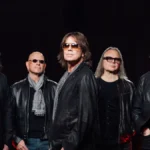

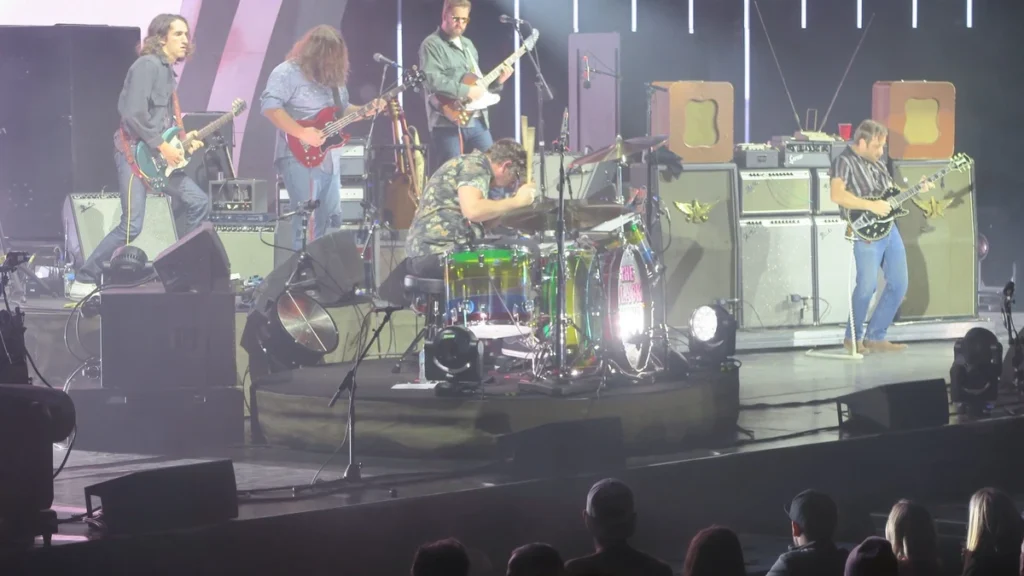
The Black Keys performing with their touring band in 2019.
The Black Keys released their fourteenth album in May, made during a year when one of them had a very good reason to be somewhere else.
The tour behind it runs until the middle of October.
Fourteen Albums and a Claim About the First
Auerbach has described the record as the most natural set of songs the band has made since their debut, which is a specific and slightly loaded claim.
Musicians invoke an early record when they want to signal a return to a working method rather than to a sound, and it is usually shorthand for less deliberation.
The debut was made by two people in a basement with almost no equipment and no expectations attached to it, which is not a state a band fourteen albums in can simply re-enter.
What they can reproduce is the absence of a plan, and that appears to be what the comparison is pointing at.
Why It Was Made
The band have said the record came together during a period when Auerbach’s father was seriously ill, and that Carney encouraged the work partly because it would give him something to do.
That is an unusually plain thing for a band to put on the record about a record, and it is the stated reason this one exists at all.
Work as a response to something outside the work is a common experience and a rarely stated one, mostly because it invites a reading of the songs that the songs may not support.
What That Does to a Session
Records made under that kind of pressure tend to share a characteristic, and it is not sadness.
It is speed. When a studio is the one place a day has a shape, the sessions run long, decisions get made quickly and material accumulates faster than anybody planned.
The results are usually rougher and more direct than the same band would produce with a clear year and a producer’s schedule, which is consistent with the description they have given.
Where the Band Actually Started
The two of them came out of Akron, Ohio, playing a stripped two-piece version of blues derived almost entirely from one specific regional tradition.
That tradition is north Mississippi hill country blues, which is a different music from the Delta style most listeners mean by the word.
Hill country playing is built on a single repeating figure held for minutes at a time, with almost no chord movement, a droning insistence closer to West African string music than to a twelve-bar structure.
Why That Tradition Suits Two People
The choice was practical before it was aesthetic, and it explains the band’s entire early shape.
Music built on one repeating figure and a heavy backbeat does not need a bass player, because the guitar’s low strings and the kick drum between them cover the register a bass would occupy.
A twelve-bar blues, by contrast, has chord changes that a two-piece has to imply rather than play, which is why so few duos attempt it convincingly.
An EP of One Man’s Songs
Early in the career they recorded a release consisting entirely of songs by a hill country player who had died a few years before.
Devoting a whole release to one relatively obscure musician is a strong statement of debt, and it functioned as a credit line at exactly the point the band was being written about as garage rock.
It also sent a reasonable number of listeners to the original recordings, which is the only meaningful test of a tribute.
The Production Career Alongside It
Auerbach has spent much of the last decade producing other people’s records, running a studio and label operation in Nashville.
A substantial part of that work has been with older blues, soul and country musicians whose careers were largely over, several of whom made their best-selling records in their seventies.
That is a different activity from being in a band, and it has fed back into the band’s own recordings in ways that are audible in the arrangements.
Opening in a Casino Showroom
The tour began on 24 April at a casino resort in Fort Lauderdale, which is a distinctly unglamorous first night.
Casino venues pay a guaranteed fee rather than a share of the door, which makes them the safest possible place to open a tour while the production is still being worked out.
They are also a substantial and rarely discussed part of the American touring economy, particularly for acts whose audience is now in its forties.
Six Months on the Road
The routing runs from late April to 18 October, covering North America and Europe.
Six months is a long cycle, and it is structured in legs with the European dates separated from the American ones rather than interleaved.
That separation is standard and financially necessary, since moving a production across the Atlantic twice costs more than most tours can absorb.
Three Support Acts
The dates carry three different opening acts between them rather than one for the whole run.
The three come from noticeably different places: British indie rock, a newer artist, and a young blues guitarist.
Including a blues player on the bill is consistent with everything else about this band’s history, and it puts that music in front of an audience that would not otherwise seek it out.
From Two People to a Full Band
The live show now uses a full band rather than the original duo, which is a transition this group made some years ago and which some of the audience has never fully accepted.
The argument for it is straightforward: the records stopped being two-piece records long before the shows did, and reproducing them honestly requires more hands.
The argument against is that the constraint was the identity, and that a four or five-piece playing the same songs is a different proposition wearing the same name.
What Fourteen Albums Does to a Set
A catalogue this size creates the problem every long-running band eventually has.
There is more material with a genuine claim on the set than a set can hold, and the newest album always competes with songs the audience has waited years to hear.
The usual compromise is three or four new songs in a two-hour show, which pleases nobody completely and is the only arrangement that works.
A Cancelled Tour in the Background
The band has been through a publicly difficult touring period in recent years, including an arena run that did not go ahead as planned.
Episodes of that kind are usually attributed to demand, and the reality is normally a combination of venue scale, pricing and a routing that was decided too early.
What follows is generally what has happened here: a return at a more conservative scale, in rooms the band can fill comfortably.
Naming a Record and a Tour After Fruit
The album title and the tour name share a deliberately light, almost frivolous register.
That is a choice worth noticing given the circumstances the record was made in, and it is a common one: bands rarely title a difficult record after the difficulty.
A light title also protects the songs from being read exclusively through the biography, which is a reasonable thing to want.
Why the Hill Country Tradition Still Matters Here
The reason this band’s blues lineage is worth taking seriously, rather than treating as an origin story, is that it never left the records.
The trademark is a riff repeated past the point where a rock arrangement would move on, held until it becomes hypnotic rather than merely catchy. That is a hill country device, not a rock one, and it survives in songs with entirely modern production around them.
The drumming carries it too. A backbeat played slightly heavy and slightly behind, without fills, is what gives that music its trance quality, and it is the opposite of what a rock drummer is usually trained to do.
A band can add keyboards, horns, a bass player and a full studio and still be recognisably playing that tradition, which is why the blues lineage here is a description of the music rather than a note about where they came from.
What Producing Older Musicians Teaches
The production work matters to the band’s own records more than it is usually given credit for.
Recording musicians in their seventies and eighties imposes a specific discipline: they do not want to play a part forty times, they expect to record together in a room, and they will tell a producer immediately when an idea is wrong.
That pushes a session toward live takes, minimal correction and arrangements decided before the tape rolls rather than assembled afterwards.
A producer who works that way for a decade brings the habit back to his own band, and it is a plausible explanation for why a fourteenth album could credibly be compared to a basement debut.
What Is Actually Being Tested
Two things. Whether a record made quickly, in a bad year, holds up as a record rather than as a document of the year.
And whether a band that spent two decades getting bigger can go back to a working method that depended on being small.
Fourteen albums, one casino showroom in April, six months of touring, and a comparison to a basement in Akron.
About The Author




More Stories
The Sound of Burlington Rock-Blues: Off the Tracks by Brian Leduke
Matt Springfield: Poplife and Its Greg Haver Sessions, Reconsidered
How FYDStar Got Scream’s Cosmic Sludge Pop Out of a Bass and Drums Duo