





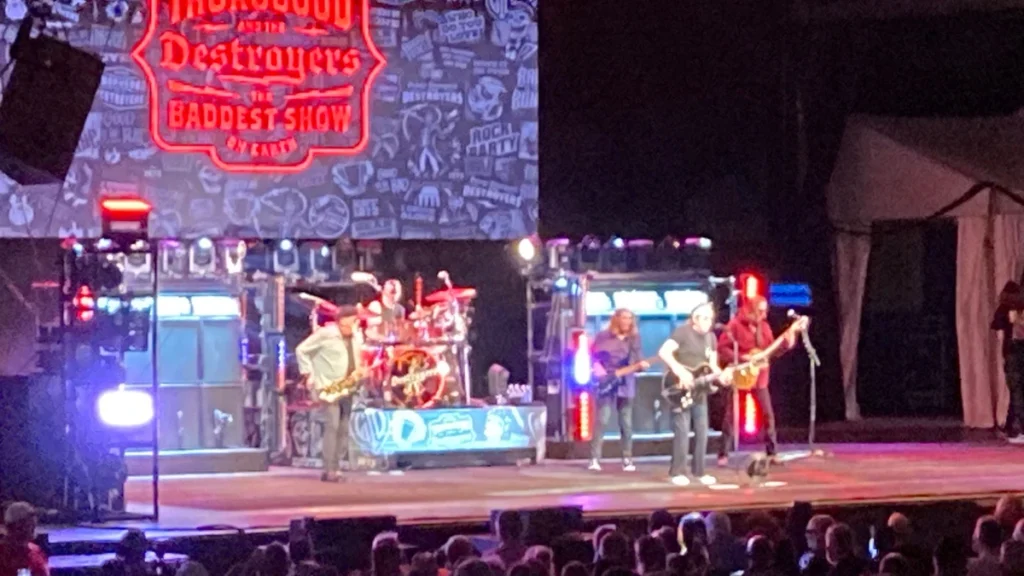
George Thorogood and the Destroyers performing at Summerfest in 2025.
George Thorogood and the Destroyers released a live album this year built from performances recorded across forty-six years.
Two British dates in June are billed as the last they will play there.
A Live Album Recorded Across Five Decades
The record draws on concert tapes made between 1978 and 2024, which is an unusual way to build one.
Most live albums document a tour, a residency or a single night, and their value is that they capture a band at one specific moment.
Assembling one across forty-six years does something else entirely: it documents a repertoire rather than a performance, and it necessarily includes several different bands playing under the same name.
What that produces is closer to an audio history than to a concert recording, which is a legitimate thing to make and a different one from what the format usually delivers.
The Problem With Spanning That Long
The technical difficulty is considerable and it is why this is rarely attempted.
A 1978 multitrack and a 2024 digital recording differ in tape noise, microphone technique, drum sound and the sheer loudness of the master, and placing them next to each other exposes every one of those differences.
Mastering a record like this is therefore an exercise in making forty-six years sound like one evening, which requires either heavy processing or an acceptance that it will not.
What the Repertoire Actually Is
The songs the band is known for are mostly not their own, and that is the most interesting fact about this catalogue.
The best-known set includes a song first recorded by Bo Diddley in the 1950s, a drinking song that reached them through John Lee Hooker, and a country record written by Hank Williams in the 1940s.
The one enormous exception is a self-written song from the early 1980s that became the band’s calling card and has appeared in a remarkable number of films and advertisements since.
Interpretation as a Career
Building five decades on other people’s material is a career shape that barely exists now and was once entirely normal.
Before the songwriter-performer became the default, an artist was expected to select and interpret rather than to write, and the skill being judged was arrangement and delivery.
What this band did was apply that older model to blues records specifically, playing them louder and faster than the originals for an audience that had mostly never heard the originals.
Where the Slide Playing Comes From
The guitar style is built on slide, and the vocabulary is traceable to a specific Chicago lineage rather than to rock.
The defining features are a heavy attack, a narrow range of positions used repeatedly, and a tone deliberately kept raw rather than smooth. That is Chicago electric blues playing, not the more fluid slide style that came out of the Delta acoustic tradition.
Playing it through a loud amplifier in front of a rock rhythm section is the whole trick, and it is the reason this music reads as rock and roll to an audience and as blues to a guitarist.
Boogie as a Rhythmic Choice
Underneath almost everything is a boogie shuffle, which is a specific and demanding rhythm to sustain.
A shuffle is played with an uneven subdivision, and holding it steady for four minutes without either straightening out or dragging is genuinely difficult across a whole band.
Bands built on it tend to have long-serving rhythm sections for exactly that reason: the feel takes years to lock and does not survive frequent personnel changes.
Why the Blues Repertoire Matters Here
There is a fair criticism of white rock acts who built careers on Black blues repertoire, and it should not be dodged.
The historical pattern is well documented: the originators were frequently unpaid, uncredited or long dead by the time the covers sold, and the money moved in one direction.
What can be said in this specific case is that the songs were credited, the sources were named consistently in interviews across decades, and a substantial number of listeners found the originals because of the covers. That does not settle the argument, but it is the part that is checkable.
Opening in California in March
The North American leg ran from 6 March in Highland, California to 4 April in Ottawa.
A month-long run across that distance is a heavy schedule for a band of this vintage, and it covers both coasts and a Canadian finish.
Early spring is also the quiet part of the touring calendar, which means less competition for the same audience’s money.
Two Nights in Britain
The British dates are 29 June in Wolverhampton and 30 June at a London venue inside a larger arena complex.
Two shows on consecutive nights is the whole British visit, which is a very small allocation for a market that supported this band for decades.
Choosing Wolverhampton alongside London rather than the usual Manchester or Glasgow is a slightly unusual pairing, and it points at where the audience actually is rather than where the industry is.
Billed as the Last One
Those two shows are described as the final United Kingdom tour, which is a specific claim rather than a general farewell.
Retiring from one territory while continuing to tour elsewhere is increasingly common and rarely explained. The reasons are almost always logistical: freight, visas, carnets and the cost of moving a production across an ocean for two nights.
It is a more honest formulation than a global farewell that runs for five years, because it commits to something specific and checkable.
Fifty Years of the Same Name
The band has operated under one name for more than five decades, with the frontman as the constant.
Longevity of that kind is unusual and it changes what the act is. After a certain point the band stops being a group of musicians and becomes an institution with a repertoire, which is why a live album spanning forty-six years is coherent at all.
It also means the current lineup is playing arrangements that predate several of its members.
A Song That Outgrew the Band
The best-known song has had a licensing life far larger than the band’s recording career.
Tracks that become shorthand in film and advertising acquire an audience with no relationship to the artist, which is lucrative and slightly hollow.
It also fixes a band in public memory at one moment, which is a difficult thing to work against for forty years.
Where It Started
The frontman came out of Delaware, which is not a place with a music industry.
Acts from states without a scene have to build an audience by touring relentlessly, because there is no local infrastructure to be discovered by.
That is a plausible origin for a band whose entire identity is the live show rather than the records.
Why a Greatest Hits Live Album Exists at All
The format looks redundant and serves a real purpose for a band like this.
The studio versions are not what the audience knows. Fifty years of touring means most listeners have heard these songs live, on the radio in live versions, or in the arrangements the band settled into rather than the ones originally recorded.
A live compilation is therefore closer to the definitive text than the studio catalogue is, which inverts the usual relationship between a band’s records and its shows.
What Forty-Six Years Does to a Song
Hearing one arrangement across that span reveals something no studio catalogue can.
Tempos are the first thing to move. A song played nightly for decades usually settles slower than the record, because a band stops rushing once it stops being nervous, and because a slower shuffle simply feels better in a room.
Keys sometimes drop, which is ordinary and rarely acknowledged. A vocal written at thirty is not always comfortable at seventy, and a semitone down is the standard, invisible fix.
Arrangements simplify. Parts that seemed essential in 1978 fall away, solos shorten or lengthen depending on what the crowd responds to, and endings get decided by fifty years of watching audiences. A compilation spanning that period is a recording of those decisions accumulating.
Retiring From One Country
Territory-specific retirement is worth understanding because it is becoming the normal shape of a long goodbye.
Moving a production internationally means freight costs measured in tens of thousands, work permits for every member and crew, customs documentation for every instrument, and currency risk on a fee agreed months ahead.
For two shows, none of that amortises. A band can tour profitably in its home market for years after the international dates have stopped making arithmetic sense, which is why the announcements come territory by territory rather than all at once.
The alternative, an open-ended global farewell, has been used so often that audiences no longer believe it. Naming one country and two dates is at least a claim that can be held to.
What Is Actually Being Tested
Two things. Whether recordings made forty-six years apart can be sequenced into something that plays as one record rather than as an archive.
And whether a career built on interpreting other people’s blues reads, five decades on, as preservation or as appropriation. The honest answer is that it is legible as both, and that the credits and the interviews are the only part of it that can be checked.
Forty-six years of tape, one boogie shuffle, two nights in Britain, and a song that got much bigger than the band.
About The Author




More Stories
The Sound of Burlington Rock-Blues: Off the Tracks by Brian Leduke
Matt Springfield: Poplife and Its Greg Haver Sessions, Reconsidered
How FYDStar Got Scream’s Cosmic Sludge Pop Out of a Bass and Drums Duo