






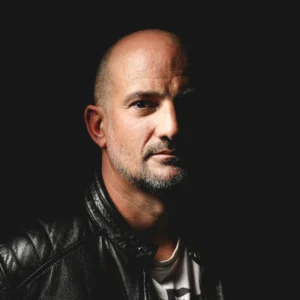
Steven Wilson performing in 2016.
Steven Wilson has given the album he is currently making a single working rule: if an idea is something AI could have produced, it goes.
He plays two concerts this year and nothing else.
A Test Rather Than a Manifesto
The rule as he states it is a question asked of every idea, which is more useful than a general position on the technology.
It is also a test that produces a specific outcome. Anything that resolves the obvious way, sits comfortably in the middle of a genre, or does what the previous eight bars implied it would do is exactly what a model trained on existing music produces well.
Applying that filter therefore pushes a writer toward decisions that are odd, awkward or unresolved, because those are the ones a statistical system is least likely to arrive at.
Whether that produces a better record or merely a stranger one is a genuinely open question, and it is the one the album will be judged on.
Deliberate Looseness From a Precise Producer
The record is intended to sound slightly shambolic, which is a pointed choice given who is making it.
This is a musician known for meticulous production, for records assembled with enormous care, and for a second career spent remixing other people’s catalogues to an exacting standard.
Deciding that the next thing should sound loose is a reversal of the working method he is best known for, and it is consistent with the AI test rather than separate from it.
Why Imperfection Is the Point
The argument underneath both decisions is that audible human error is now a signal rather than a flaw.
For thirty years the direction of travel in recording was toward correction: timing tightened, pitch adjusted, performances assembled from fragments until nothing was audibly wrong.
Once a machine can generate something with no errors at all, the errors become the evidence that a person was there, which inverts the value of the last three decades of studio practice.
The Album Before This One
His eighth studio album arrived in March 2025 through Fiction Records and consisted of two pieces of roughly twenty minutes each.
Two long tracks is a deliberately unfashionable structure, and it is the defining formal gesture of progressive rock: music that takes as long as its argument requires rather than as long as a format allows.
It reached number three in Britain and was voted album of the year by both of the magazines that cover this field, which is about as complete a reception as the genre offers.
Returning to Progressive Rock
That record was framed as a return, since the preceding work had moved substantially into electronic territory.
Artists who move away from the genre that made them usually find the return covered as a capitulation, and sometimes it is.
The more interesting reading is that someone who has spent time working in pop and electronic structures brings different instincts back to a twenty-minute piece than they took away from it.
Two Concerts and Nothing Else
He plays only two shows this year, both at the Royal Albert Hall, on 28 and 29 October.
Restricting a year to two concerts is a decision to make attendance an event rather than a choice of dates, and it concentrates an international audience into one building on two nights.
It is also, straightforwardly, what an artist does when the studio is the priority and touring would consume the year.
A Seventh Time at the Same Hall
These are his seventh appearances at that venue, which is an unusual relationship between an artist and a room.
The Albert Hall is a circular Victorian building with famously difficult acoustics, and it is not a room every act sounds good in.
Returning to it repeatedly suggests a performer who has learned how to use the space, which for orchestral material matters more than the capacity does.
An Orchestra and a Choir
The shows feature an orchestra and a choir performing previously unheard arrangements of the 2025 album.
New arrangements rather than the recorded versions is the entire justification for the format, since an orchestra reproducing a record note for note is an expensive tribute to itself.
It also gives an audience that already owns the album a reason to attend, which is the practical problem every orchestral rock show has to solve.
Why Orchestral Prog Shows Are Hard
Putting a rock band and an orchestra on one stage creates problems that are mostly about volume and timing.
An orchestra plays to a conductor and a rock band plays to a drummer, and reconciling those two timekeeping systems is the single largest technical difficulty in the format.
The usual solution is a click track, which solves the synchronisation and removes exactly the elasticity an orchestra is there to provide.
The Band That Started as a Hoax
The project that made his name began as an invention rather than a band.
In the late 1980s he and a friend fabricated a fictional group, complete with an imagined history involving a legendary and entirely non-existent psychedelic act from the previous decade, and recorded music attributed to it.
The joke required the music to be convincing, and that is the part that mattered: to sell a fake 1970s psychedelic band you have to actually make a persuasive 1970s psychedelic record.
What Faking Psychedelia Requires
Reproducing that idiom convincingly is a genuine technical exercise and not a matter of adding effects.
The signatures are specific: tape-based delays that drift rather than repeat cleanly, backwards recordings that only work if the part was written to be reversed, drones held under chord changes, and a mix where instruments swap places between the speakers.
Almost all of it depends on the recording process rather than the composition, which is why a hoax band was a training in production long before it became a career.
The joke outlasted the joke. The fictional band became a real one and ran for decades, and the psychedelic apparatus stayed in the toolkit long after the pastiche was dropped.
Remixing Other People’s Catalogues
A substantial part of his working life has been spent producing new stereo and surround mixes of classic albums by other bands.
That work involves returning to the original multitrack tapes, which are frequently in poor condition and occasionally incomplete, and rebuilding a record that listeners have known for fifty years.
It is a job with almost no upside and considerable risk, since a familiar record remixed badly is an act of vandalism to the people who love it most.
What Archive Work Teaches
Spending years inside other people’s tapes changes how someone makes their own records, and the effects are practical.
Hearing a famous album as separate tracks reveals how much of its character comes from mistakes, from arrangements that were clearly compromises, and from decisions made because a session ended rather than because they were right.
A producer who has learned that tends to be less precious about perfection in their own work, which connects directly to a record deliberately made to sound loose.
Progressive Rock and Its Reputation
The genre has been critically dismissed for most of its existence and commercially substantial throughout.
The standard objection was that technical ambition displaced feeling, which was always more a statement of preference than an argument.
What has changed is that the people who made that case have largely stopped writing, while the audience never went anywhere and the musicians it influenced now work across several genres.
Why the AI Question Lands Hardest Here
Progressive rock is an unusually exposed genre for this particular test, and it is worth explaining why.
A great deal of prog is formally conventional underneath the complexity. Odd time signatures, extended suites and modal harmony are all patterns, and patterns are precisely what a trained model reproduces well. A convincing pastiche of a 1972 prog record is one of the easier things to generate.
What a model does badly is the specific, the unresolved and the wrong-sounding decision that turns out to be right. A twenty-minute piece has enormous room for those choices and equally enormous room to fill time with competent, predictable development.
Applying an anti-AI filter inside this genre therefore cuts against its own worst habits, which may be the most useful thing about the rule regardless of what one thinks of the technology.
Two Nights Instead of a Tour
The economics of playing twice rather than touring are worth stating, because they run counter to how the industry works.
A tour amortises a production across dozens of shows. Two nights carries the entire cost of building an orchestral production, rehearsing an orchestra and a choir, and preparing arrangements that will be performed twice and then never again.
That only works if both nights sell at a price that covers it, which in turn requires an audience willing to travel internationally for a specific evening.
Artists with that kind of following are rare, and the ones who have it increasingly prefer this shape: fewer, larger, unrepeatable events rather than a year on the road playing the same set.
What Is Actually Being Tested
Two things. Whether a rule defined against what a machine would produce is a useful compositional constraint or an interesting piece of framing that the songs will have to survive.
And whether deliberate looseness from a producer known for precision reads as honesty or as an affectation, which is a judgement only the record can settle.
One question asked of every idea, one album due in October, two nights in a round Victorian hall, and nothing else all year.
About The Author




More Stories
The Sound of Burlington Rock-Blues: Off the Tracks by Brian Leduke
Matt Springfield: Poplife and Its Greg Haver Sessions, Reconsidered
How FYDStar Got Scream’s Cosmic Sludge Pop Out of a Bass and Drums Duo