
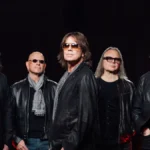
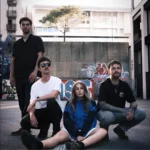
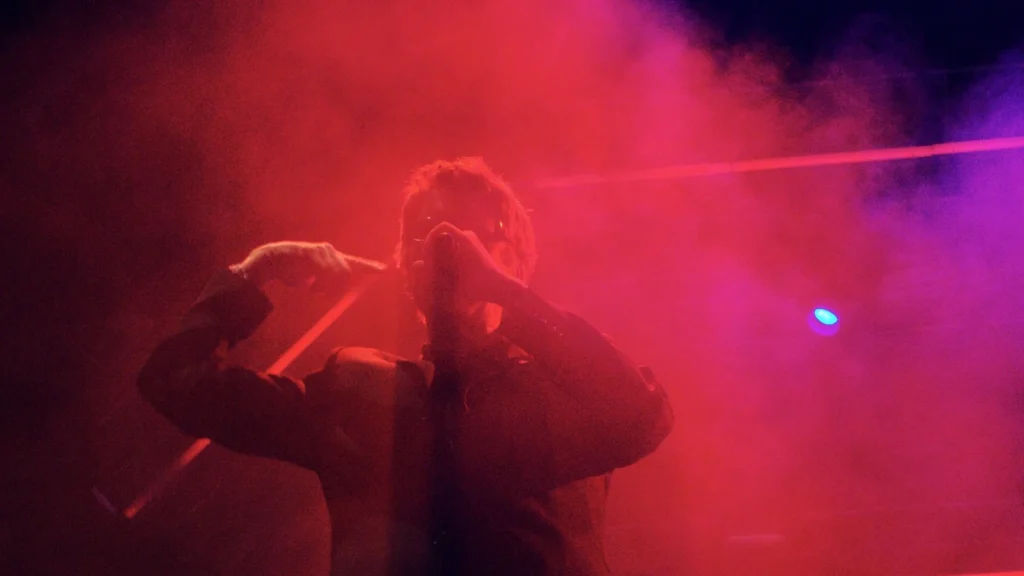
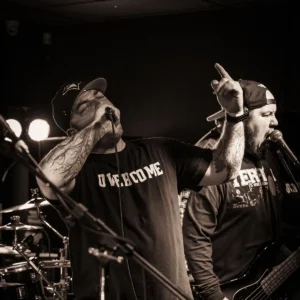
The Psychedelic Furs performing live.
The Psychedelic Furs cancelled their spring dates in May after their bassist needed heart surgery, then toured through the summer anyway.
Eleven more dates were added for the autumn.
A Cancellation With a Stated Reason
The spring and summer trek was pulled in early May after bassist Tim Butler required triple bypass surgery.
Bands cancel tours constantly and the stated reasons are usually vague, which trains audiences to assume slow ticket sales whatever the announcement says.
Naming the medical reason plainly is the less common choice, and it is the one that makes a subsequent return legible rather than suspicious.
It also sets expectations correctly: an operation of that kind has a recovery period measured in months, not weeks.
Returning at the End of July
The rescheduled co-headline run began on 31 July in Park City, Utah and ran to 6 September in Miami Beach.
Roughly three months between the surgery and the first date is a fast return by any standard, and touring is physically demanding in ways that have nothing to do with the performance.
Bass is also among the more physical instruments to play standing for ninety minutes, which is worth noting rather than glossing.
More Than Twenty Concerts
The summer run covered more than twenty dates across the United States.
That is a substantial schedule for a band whose members are well into their sixties, and it is the shape heritage touring now takes: dense runs of several weeks rather than a spread across a year.
Concentration is the point. A band that plays twenty dates in six weeks incurs one set of travel costs and one set of production costs.
Sharing the Bill
The tour was co-headlined with Living Colour, which is a pairing of two acts from adjacent scenes rather than the same one.
Both emerged in the 1980s American alternative landscape and both had genuine chart success without ever becoming mainstream rock acts.
Package bills of that kind work because the audiences overlap heavily by age and outlook while the music does not, which gives an evening more variety than a single headliner provides.
Eleven Dates Added for Autumn
A further eleven West Coast dates run from 29 October in Rocklin, California to 19 November in Phoenix.
Adding a leg after a summer run usually means the summer sold, and it is the clearest available signal that a rescheduled tour recovered its audience.
A different support act appears on those shows, which is normal when dates are added late and the original opener has other commitments.
A Band Named for a Sound They Are Not
The name has caused forty years of confusion, since the band is post-punk rather than psychedelic.
Their music is built on the things that defined the form: a prominent, melodic bass line, angular guitar, saxophone used as texture rather than as a solo instrument, and a hoarse spoken-sung vocal.
The psychedelic reference was always partly a joke and partly a nod to an earlier era, which was extremely common in band names of that period.
What Post-Punk Actually Was
The original wave was a reaction against punk’s musical narrowness rather than a continuation of it.
Where punk simplified, post-punk borrowed: dub bass, funk rhythm, electronics, and the willingness to sound cold rather than aggressive.
That is why bands filed under the label sound so different from one another, and why the term describes an attitude to influences more than a set of musical traits.
The Bass Carries It
In this band’s case the bass is not accompaniment, which makes the player’s absence a structural problem rather than a staffing one.
Post-punk arrangements typically put the melodic weight in the bass and leave the guitar to provide texture above it, inverting the standard rock hierarchy.
A band built that way cannot simply hire a deputy for a few weeks, because the part is the identity rather than the foundation.
Two Brothers in the Same Band
The group has been fronted by two brothers for its entire existence, which is both its stability and its constraint.
Sibling bands survive arguments that would end other groups, because the relationship predates the band and outlasts it.
They are also uniquely exposed to a health event affecting either one, since there is no version of the group that continues without both.
A Record After Twenty-Nine Years
Their most recent album arrived in 2020, their first new record in nearly three decades.
Gaps of that length usually produce a nostalgia exercise, and this one was received as a genuine record rather than a curiosity.
What makes that possible is almost always the same thing: a band that kept touring through the gap and therefore never stopped being a functioning group.
Living on One Song
Public memory of this band outside its own audience rests heavily on a single song attached to a 1980s film.
Film synchronisation is the most powerful preservation mechanism in popular music, and it is almost entirely a matter of luck rather than merit.
The cost is that a substantial catalogue gets compressed into one title, and every set list has to negotiate with that fact.
Why Eighties Alternative Acts Still Tour
A large number of bands from this period are working steadily, and the reason is demographic rather than musical.
Their original audience is now in its fifties and sixties, with disposable income and a strong attachment to music discovered young.
That audience buys tickets reliably and does not require new material, which sustains a touring economy almost invisible to the wider industry.
What a Health Cancellation Costs
The financial mechanics of pulling a tour are worth stating, because they explain why bands are so reluctant to do it.
Deposits are paid to venues, crew are contracted, buses and trucks are held, and much of that is non-refundable at short notice. Refunded tickets return money the band has frequently already spent on production.
Insurance exists and is expensive, and policies increasingly exclude pre-existing conditions for older performers, which is the category most heritage acts fall into.
The result is a real pressure to play through things that should not be played through. A band that cancels and says why is absorbing a cost most would rather avoid, which is the part worth respecting in the announcement.
Rescheduling Is Harder Than Cancelling
Putting a cancelled tour back together is a bigger job than the original booking, and it is rarely appreciated.
Venues have already resold the dates. Support acts have taken other work. The routing that made geographic sense in spring does not survive being moved to autumn, because everybody else’s calendars have filled in the meantime.
What usually emerges is a shorter, more regionally concentrated run than the original, which is exactly the shape of the eleven West Coast dates here.
That is not a downgrade. It is what a rebuilt tour looks like when the alternative is not touring at all.
What Is Actually Being Tested
Two things. Whether an audience that had its tickets refunded in May comes back in October, which is the real measure of a rescheduled tour.
And whether a band whose sound depends on one specific bass player can keep touring at this density, now that the answer to that question has been made public.
One cancellation, one operation, twenty summer dates, eleven autumn ones, and a band still named after the wrong genre.
About The Author


More Stories
The Sound of Burlington Rock-Blues: Off the Tracks by Brian Leduke
Matt Springfield: Poplife and Its Greg Haver Sessions, Reconsidered
How FYDStar Got Scream’s Cosmic Sludge Pop Out of a Bass and Drums Duo