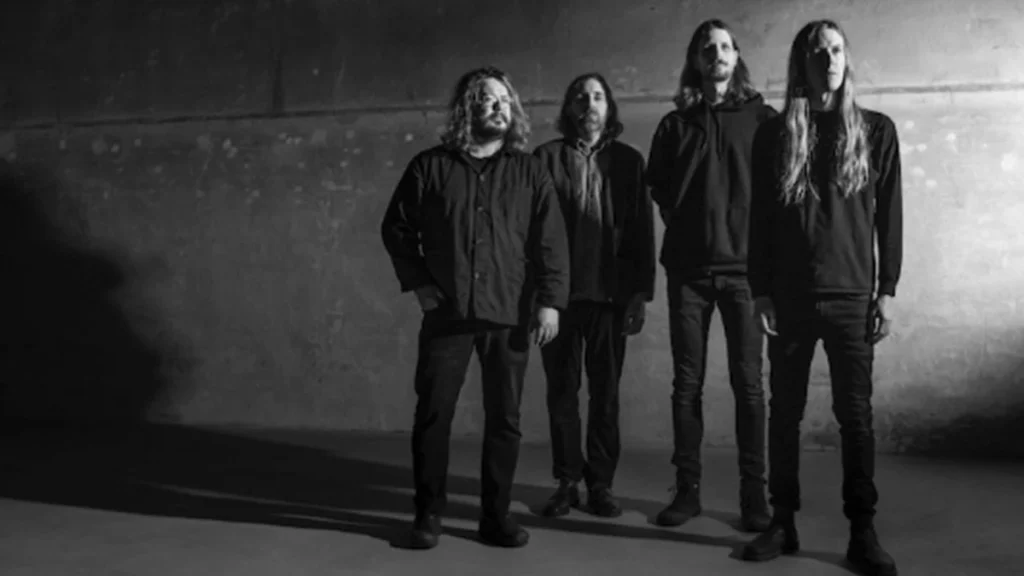
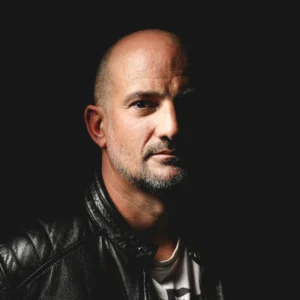
Elder, press photograph issued with the Through Zero announcement.
Elder released a new album in May that was recorded in the gaps between tours, in a Berlin studio, over a winter.
They headline North America across September and October.
An Album Made in the Gaps
Recording across a winter in sessions fitted between tour legs is a working method with visible consequences.
A band that books a studio for six weeks writes toward a deadline and arrives with material largely finished. A band recording in fragments arrives repeatedly, each time slightly different from the last.
What that produces is a record assembled rather than captured, and for long-form music it can work in the band’s favour, since sections written months apart do not have to sound like they were written on the same afternoon.
The risk is coherence, and it is the thing a record made this way has to prove.
Why Berlin
The sessions took place at a Berlin studio, which is not where an American band would obviously record.
Berlin has become a practical base for heavy and psychedelic bands from several countries, for reasons that are economic before they are cultural: rehearsal and studio space remain affordable relative to other European capitals, and the city sits in the middle of the continental touring map.
For a band whose audience is substantially European, recording there removes the transatlantic flight from the middle of the process.
Progressive Construction, Psychedelic Surface
The coverage around this record has settled on describing it as progressive psychedelia, which is more accurate than either word alone.
The surface is psychedelic: heavy fuzz tone, extended instrumental passages, arrangements built on repetition and gradual change rather than on verses.
The construction underneath is progressive. Pieces run past ten minutes, move through distinct sections, and return to earlier material transformed, which is composition rather than jamming.
What Separates the Two
The distinction is worth making precisely, because the words are frequently used interchangeably.
Psychedelic rock is fundamentally about texture and perception: what the sound does to the listener, achieved through effects, repetition and volume.
Progressive rock is about structure: how much a piece of music can be asked to hold, achieved through composition and arrangement.
A band can do one without the other. Doing both means writing structures rigorous enough to survive being played at a volume that makes structure hard to follow.
Riffs as Building Material
The band’s method starts from riffs rather than from chord progressions, which is a specific compositional choice.
A riff is a fixed melodic and rhythmic figure, and it can be treated the way a classical composer treats a theme: transposed, inverted, played at half speed, handed to a different instrument, or set against itself.
That is why heavy bands working in long forms sound more like formal composition than their volume suggests, and it is the technique this band has built five albums on.
Following a Well-Received Record
The new album follows one from 2022 that was widely regarded as the band’s best.
Following a record like that is a specific problem. Repeating it disappoints; departing from it disappoints differently.
The usual solution is to change one variable rather than several, which lets an audience recognise the band while hearing something new, and it is the least dramatic and most reliable option available.
A Summer of European Festivals
The band spent the summer on the European festival circuit, including several of the largest heavy music events on the continent.
Those festivals are the economic backbone of this genre. A band can earn more from six festival appearances than from a month of club dates, with a fraction of the travel.
They are also where an audience is recruited, since a substantial part of every festival crowd is watching a band for the first time.
Playing Metal Festivals as a Psych Band
The festivals they played are metal events rather than psychedelic ones, which is a useful position to occupy.
Heavy psych sits between scenes: loud and downtuned enough for a metal bill, strange and instrumental enough for a psychedelic one.
Bands who can credibly play both circuits roughly double the number of bookings available to them, which in a genre with no radio presence is a substantial structural advantage.
Headlining North America
The autumn brings a North American headline run across September and October.
Headlining is a different proposition from the festival slots that preceded it. A festival set is forty minutes of the most direct material; a headline set is ninety minutes and can include the long pieces the records are actually built from.
For a band whose songs run past ten minutes, that difference determines whether the live show represents the catalogue at all.
Two Support Acts
Two bands share the opening slots across the run rather than one covering all of it.
Both come from adjacent corners of the same scene, which makes the bill coherent for an audience that follows the genre rather than any single act.
Partial support arrangements usually reflect the openers’ own schedules rather than the headliner’s preference, and they mean the bill differs by city.
An American Band With a European Audience
The band originated in the United States and has built a following that is substantially European.
That inversion is common in heavy psych, doom and stoner rock, where European festival infrastructure and audience density support the music far better than the American circuit does.
It produces bands who tour Europe more than their home country and, in several cases, relocate there.
Already Booked Into 2027
European and British dates are already scheduled for February 2027.
Booking eighteen months ahead is normal at festival level and unusual for club touring, and it indicates a booking agent working from a position of confidence.
It also means the album has a two-year touring life planned before it has had a full year of release, which is the shape a genre without radio depends on.
What Long Songs Cost a Band
Writing in ten and twelve minute pieces has practical consequences that shape everything about a career.
A set list holds six or seven songs rather than eighteen, which means every one has to be strong and there is nowhere to hide a weaker piece in the middle.
Radio is closed off entirely, as is playlist placement, so the band is dependent on live performance and on listeners who will commit to an album rather than a track.
The compensation is loyalty. An audience that has invested the attention a twelve-minute piece demands tends to stay for a decade, which is why bands in this field have unusually long and stable careers on unusually modest numbers.
Recording Between Tours as the New Normal
The method behind this record is increasingly how albums at this level get made, and it is worth being clear about why.
Touring is where the income is, and a band that stops for three months to record loses the income and keeps the costs. Studio time therefore has to fit around the road rather than the other way round.
Cheap, high-quality recording makes it possible. A studio session that would once have required a continuous block can now be split across a winter, with files carried between sessions and nothing lost technically.
What is lost is momentum, and bands who work this way consistently describe the same difficulty: returning to material after six weeks away, unsure whether the version in their head is the one on the drive. The records that survive it are the ones where somebody kept an overall shape in mind while everybody else was on a bus.
What Is Actually Being Tested
Two things. Whether a record assembled across a winter of interrupted sessions holds together as one piece of work, which is the specific risk of the method.
And whether a band following its best-reviewed album can move without losing the audience that album earned.
Five albums, one Berlin studio, a winter of interrupted sessions, and a headline run that finally has room for the long ones.
About The Author

More Stories
The Sound of Burlington Rock-Blues: Off the Tracks by Brian Leduke
Matt Springfield: Poplife and Its Greg Haver Sessions, Reconsidered
How FYDStar Got Scream’s Cosmic Sludge Pop Out of a Bass and Drums Duo