



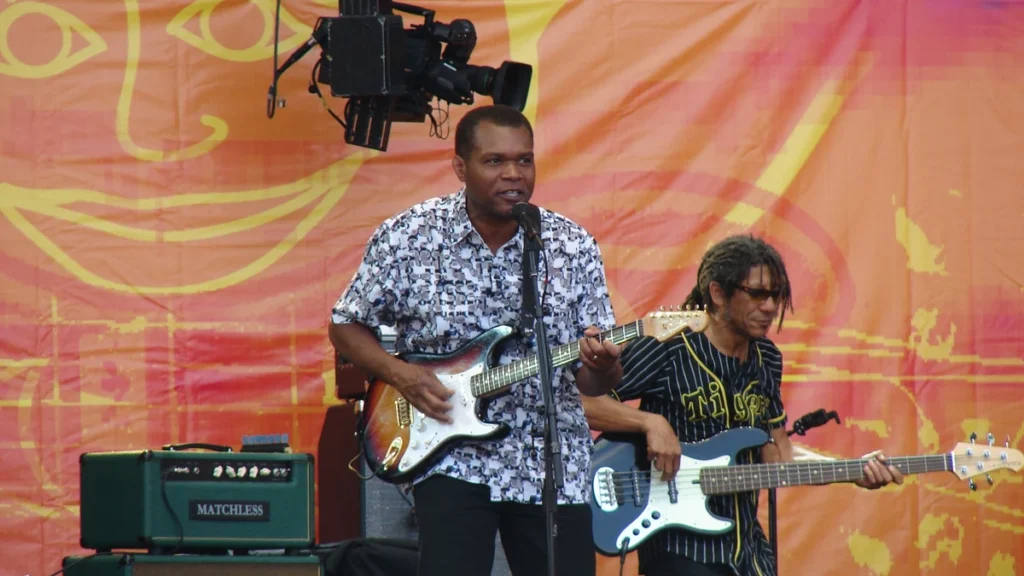
Robert Cray performing with his band.
Robert Cray is touring American theatres this year, forty years after the album that took him out of the blues circuit.
The dates run from Colorado in June to Mississippi in October.
The Record That Changed the Category
The 1986 album did something the blues had almost stopped doing: it reached mainstream American radio without being repackaged as rock.
That mattered structurally rather than sentimentally. By the mid-1980s blues was understood by the industry as a heritage category, sustained by festivals and reissues, with no expectation of new records crossing over.
An album that charted and produced a radio single reset that assumption for a decade, and a substantial number of blues careers were signed in its wake.
Forty years later the anniversary is worth marking for what it made possible rather than for the record alone.
Why It Crossed Over
The crossover was not an accident of timing, and the mechanism is audible.
The playing is blues, but the production, the song structures and the vocal delivery come from soul and contemporary R and B rather than from Chicago or the Delta.
That combination made the records legible to radio programmers who would not have played a twelve-bar shuffle, and it is why the music is filed under blues while sounding almost nothing like the records that defined the term.
A Guitar Style Built on Restraint
His playing is unusual in a field that rewards volume and speed.
The tone is clean rather than overdriven, the vibrato is narrow and controlled, and the phrases are short with substantial gaps between them.
That is a harder approach than it sounds. A clean tone exposes every inaccuracy that distortion would hide, and leaving space requires confidence that the next phrase will be worth waiting for.
Singing as the Main Instrument
The guitar is the reputation and the voice is arguably the more distinctive asset.
It is a soul voice rather than a blues shout, closer to the Memphis vocal tradition than to the older declamatory style, and it carries the songs in a way the guitar deliberately does not.
Blues guitarists who can genuinely sing are a smaller group than the genre’s history suggests, and it is usually what separates a touring career from a supporting one.
The Americana Recognition
Alongside the blues honours he holds a lifetime achievement award from the Americana Music Association.
That is a meaningful classification rather than a courtesy. Americana covers roots-derived music that country and rock radio would not accommodate, and it is where a great deal of soul-inflected blues has been filed for the last two decades.
An artist recognised by both the blues establishment and the Americana one is being read as a roots musician rather than a genre specialist, which is the more accurate description of the catalogue.
Recording With a Memphis Rhythm Section
One of his more recent records was made with a rhythm section drawn from the classic Memphis soul studios.
Those players developed a specific approach: play behind the beat, leave enormous space, and never fill a gap that the singer might use.
Recording with them is a statement about where the music actually comes from, and it sits closer to the soul tradition than to any blues-rock lineage.
Theatres Rather Than Clubs
The routing runs through seated theatres and arts venues rather than blues clubs.
That suits the material. Music built on dynamics and a clean guitar tone needs a room where quiet is possible and the audience is facing forward.
It also reflects the audience, which is older, will book ahead and would rather sit down.
An Outdoor Auditorium in Colorado
The June date is at a historic Colorado auditorium, a wooden building in a mountain park.
Venues of that kind are acoustically excellent and logistically awkward, with limited access and weather exposure.
They also draw an audience that comes for the setting as much as the bill, which for an artist forty years past a breakthrough is a useful additional reason to buy a ticket.
Three Nights in Virginia
September brings three Virginia dates in different towns.
Clustering several shows in one state is efficient routing and it reflects where this audience actually lives, which is not confined to major cities.
Mid-sized American theatres in secondary markets are the working circuit for this music, and they are chronically under-covered.
A Restored Theatre in Mississippi
The October date is at a restored theatre in Hattiesburg.
Playing Mississippi carries an obvious weight for a blues musician, though this artist’s music comes from the Pacific Northwest and Memphis rather than from the Delta.
Restored 1920s theatres have become the standard venue for this circuit across the American South, and they are frequently the best-sounding rooms in their towns.
Five Decades of the Same Band Name
He has toured under the same band name for more than fifty years.
Longevity at that length depends on a working rhythm rather than on sustained success: enough dates to keep a band employed, and enough stability that the personnel do not turn over constantly.
It also means the current live show is played by musicians who have known the material for decades, which is audible in how little of it is signposted.
What an Anniversary Tour Is Not
The tour is not billed as an anniversary run, which is a small but real distinction.
A tour named for a forty-year-old album commits to playing it, and frequently to playing it in order, which turns a working band into a performance of its own history.
Touring in the anniversary year without that framing keeps the set open, and it is the choice of an artist still releasing records rather than curating a catalogue.
Why the Crossover Never Repeated
The commercial moment that album created did not last, and understanding why explains the shape of every blues career since.
Radio consolidated. Formats narrowed through the 1990s, and the space where a blues record could sit next to a rock or soul single closed almost entirely, not through hostility but through the disappearance of any format broad enough to hold it.
What replaced it is what sustains this music now: festivals, theatre touring, physical sales at the merchandise table and a specialist press. That is a smaller economy and a stable one.
The consequence is that a record like the 1986 one is no longer possible in the same way, because the mechanism that carried it no longer exists. Artists in this field build audiences one theatre at a time instead, which is slower and does not produce breakthroughs.
What Forty Years Does to a Signature Song
Playing the same handful of well-known songs for four decades creates a specific relationship between a musician and their catalogue.
The audience needs them, and an artist who drops them is punished for it. But a song played nightly for forty years cannot be performed with the same attention it received in 1986, and pretending otherwise produces a hollow version.
What generally happens instead is that the arrangement quietly evolves. Tempos settle, keys occasionally drop, solos change entirely, and the version an audience hears in 2026 shares a melody with the record and very little else.
That is not decline. It is the difference between a recording, which is fixed, and a song, which is not.
What Is Actually Being Tested
Two things. Whether an artist can tour a fortieth anniversary year without turning the show into a retrospective, which is the choice implied by not naming the tour after the record.
And whether a career built on a crossover that the industry can no longer reproduce reads as a historical accident or as a body of work that outlasted the moment.
Forty years, five decades of the same band name, a wooden auditorium in Colorado, and a restored theatre in Mississippi.
About The Author



More Stories
The Sound of Burlington Rock-Blues: Off the Tracks by Brian Leduke
Matt Springfield: Poplife and Its Greg Haver Sessions, Reconsidered
How FYDStar Got Scream’s Cosmic Sludge Pop Out of a Bass and Drums Duo