



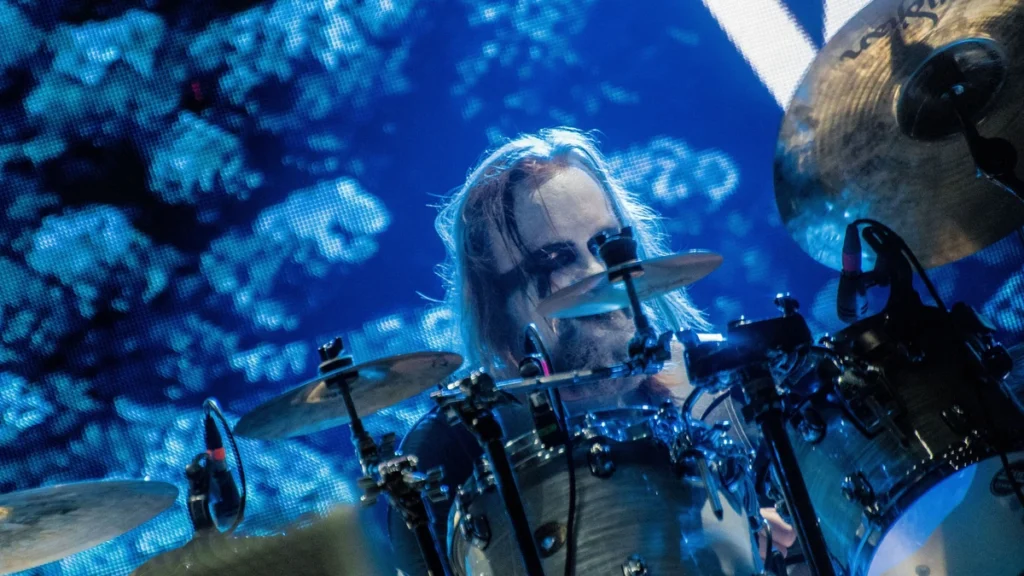
Dark Funeral performing at Rock al Parque in 2018.
Dark Funeral released a live album on 21 August recorded four years earlier in Stockholm.
It documents the touring set built around their last studio record, and closes that cycle before the next one begins.
Four Years Between Recording and Release
The gap is the most unusual thing about the release and it is not an accident.
Live albums are recorded routinely and released rarely, because a multitrack recording of a good night is cheap to capture and expensive to mix, master and package.
Bands therefore record far more shows than they ever put out, and the tapes sit until there is a commercial reason to finish them.
That reason is usually the end of an album cycle, when a live record can close a chapter without requiring anybody to write new material.
What a Live Album Is For Now
The format had a clear function when live recordings were the only way to hear a band play outside a venue.
That function disappeared entirely. Any listener can watch a phone recording of last night’s show within hours, from several angles, for nothing.
What survives is the document: a properly captured, properly mixed record of what a band sounded like at a specific point, which no phone recording provides.
Recorded in One Room
The album comes from a single Stockholm venue rather than being assembled from multiple nights across a tour.
Composite live albums are the norm, built from the best performance of each song across many shows, which produces a technically superior record that never actually happened.
A single-venue recording is a real evening including whatever went wrong, which is a different and more defensible kind of document.
Thirteen Tracks and Seventy Minutes
The running time is close to a full headline set rather than a selection.
Live albums are frequently trimmed to fit a single disc or to remove weaker performances, which turns the set into a highlights package.
Releasing the set at close to its performed length preserves the sequencing, which for a band whose shows are built as a continuous piece matters more than it would elsewhere.
Closing an Album Cycle
The release completes the campaign around the previous studio album, which came out several years ago.
Album cycles in metal run long: a record is released, toured for two or three years, and then formally closed before writing begins.
Marking that boundary with a live document is a tidy convention, and it gives the audience something during the gap before the next studio record.
An October Package Tour
A European run follows in October, sharing bills with two other established black metal bands across ten countries.
Package tours of that kind are the standard economic structure of the genre, since three bands with overlapping audiences fill rooms none could fill alone.
They also compress a genre’s touring into a shorter window, which is why so many European metal tours happen in the same few weeks.
Ten Countries in One Month
The routing covers Switzerland, Germany, Luxembourg, Italy, France, the Netherlands, the Czech Republic, Finland, Sweden and Denmark.
European touring at that density is only possible because the distances are short and the venue network is dense, which is why the continent supports more touring than anywhere else.
Three bands travelling together also share production, transport and crew, which is the main reason the format persists.
Swedish Black Metal
The band came out of the Swedish scene of the early nineties, which developed alongside and in some tension with the Norwegian one.
The Swedish approach tended toward speed and precision rather than the deliberately raw production associated with its neighbour.
Thirty years later that distinction has largely dissolved, but the bands who established it remain identifiable by it.
Corpse Paint as a Uniform
The visual presentation has remained consistent for the band’s entire existence, which is unusual for any act over three decades.
Costume in this genre functions as anonymity as much as theatre, replacing individual identity with a collective one.
That is the opposite of how most rock presentation works, where the point is usually to make the frontperson recognisable.
Four Vinyl Formats
The release comes as a standard black double LP, a limited transparent red pressing, a CD and a high resolution digital edition.
The limited coloured pressing exists to sell out, which creates the scarcity that drives preorders and, later, a secondary market.
Four hundred copies is a genuinely small run, small enough that it will be gone before most of the audience knows it existed.
High Resolution Audio for a Live Record
Offering a high resolution digital edition of a live album is a specific choice worth examining.
The audible benefit of higher sample rates is contested and probably marginal for most listeners on most systems.
What is not contested is that a live multitrack has more dynamic range than a compressed studio master, so the format at least has something to carry.
Video Singles From a Live Album
Several tracks were released ahead of the album as live videos rather than audio singles.
That is the only sensible promotion for a live record, since the selling point is the performance and audio alone cannot convey it.
It also gives the label something to push through video platforms, which for heavy music now outperform radio comprehensively.
Why Metal Still Buys Physical
The four-format release strategy only makes sense because this audience still buys objects.
Heavy music never fully transitioned to streaming-only consumption, partly because the artwork tradition is strong and partly because the audience is collector-minded.
Labels in the genre consequently plan releases around physical formats first and streaming second, which is close to inverted from the rest of the industry.
What Actually Makes a Live Album Good
The format has a poor reputation and the reasons are technical as much as artistic.
The core problem is that a live recording captures a room, and a room is where most of the excitement of a concert actually lives. Crowd noise, physical volume and the sense of being present do not survive to a recording, and what is left is often a slightly worse version of the studio arrangement.
The records that work solve this by not competing with the studio versions. They capture arrangements that changed on the road, tempos that settled somewhere different, or a band playing with an aggression the studio flattened.
For a genre built on speed and density, the live version is frequently faster and dirtier than the record, which is exactly the argument for releasing one.
Documenting a Set That No Longer Exists
The most useful function of a live album is archival, and it is the one least discussed.
A touring set is assembled, refined over two years and then dismantled permanently when the next album cycle begins. Songs dropped at that point frequently never return, and arrangements developed over hundreds of shows disappear with them.
Without a recording, that version of the band exists only in the memory of the people who attended, which for a set played across a few dozen cities is a small number of people.
Releasing it four years later, once the cycle is definitively over, is the point at which the document has the most value and the least commercial competition from the band’s own current activity.
What Is Actually Being Tested
Two things. Whether a live album still has a purpose in a period when every show is filmed by the audience and uploaded within hours.
And whether closing an album cycle formally, four years after the record, keeps an audience engaged through a gap or simply marks how long the gap has been.
Thirteen tracks, one Stockholm night in 2022, four formats, and ten countries in October.
About The Author


More Stories
Matt Springfield: Poplife and Its Greg Haver Sessions, Reconsidered
How FYDStar Got Scream’s Cosmic Sludge Pop Out of a Bass and Drums Duo
Overcome by FISTFIGHT HXC, Reconsidered: Regina Hardcore with a Thrash Pulse