



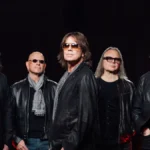


My Dying Bride performing at a festival.
My Dying Bride have collected their first six years onto eight records, with the albums recut at half speed.
Peaceville released it on 21 August.
What Half-Speed Mastering Actually Is
The term appears on a great many reissues and is almost never explained, so it is worth doing properly.
Cutting a vinyl master means driving a heated stylus across a lacquer disc while the audio is played into it, carving a groove whose shape is the waveform. The cutting head has to physically move fast enough to trace every frequency.
High frequencies are where that breaks down, because the head is being asked to make very rapid movements while the lacquer is turning at full speed. The usual result is a slight softening at the top end.
Playing the tape at half speed while turning the lacquer at half speed halves the demand on the cutting head, which then has twice as long to trace the same waveform. The pressing plays back at normal speed and the top end is more accurate.
What It Does Not Do
The technique is frequently sold as though it improves everything, and it does not.
It cannot add information that was never on the tape, and a record made from a poor source will sound like a poor source cut carefully.
It also complicates bass, since low frequencies at half speed sit at the edge of what the cutting system handles well, which is why not every album benefits.
Cutting It at Air Studios
The mastering was done at Air Studios in London, which is among a small number of British rooms still cutting vinyl to this standard.
Vinyl mastering nearly disappeared as a profession, and the engineers who can do it are a limited group with a finite number of working lathes.
That scarcity is why reissue campaigns advertise the room and the engineer, which would have been an odd thing to promote thirty years ago.
Eight Records for Six Years
The set covers an early demo, a seven-inch, and four studio albums released across the first half of the nineties.
Eight LPs for four albums means the material is spread across more sides than the original pressings used.
Spreading a record over more sides is itself an audio decision: shorter sides allow wider groove spacing, which permits higher levels and less inner-groove distortion.
Starting With a Demo
Including the demo and the seven-inch places the band’s formative recordings alongside the albums as part of the same body of work.
Most anthology sets treat pre-album material as an appendix, and putting it first instead argues that the identity was already present.
For a band whose sound changed substantially across those years, that sequencing is a claim rather than a convenience.
The Four Albums
The studio records collected here trace a specific and fairly rapid evolution.
The first is closest to death metal, built on downtuned riffs and growled vocals. By the fourth, the arrangements carry violin, clean singing and structures owing more to romantic music than to extreme metal.
Four albums is a short span for that much change, and it happened because the band was in its early twenties and working continuously.
Death Doom as an English Invention
The subgenre the band helped establish came out of northern England at the start of the nineties, and its geography is not incidental.
Three bands on the same label, from the same part of Yorkshire and Lancashire, arrived at a similar idea at the same time: take death metal’s weight and slow it down until it becomes mournful rather than aggressive.
That combination had not existed, and it has since produced a genre with a substantial international following that still centres on those original records.
The Label That Named a Scene
Peaceville was an independent operating from a Yorkshire bedroom before it became one of the defining metal labels of the decade.
Its early roster is now referred to collectively, which is unusual. Very few labels become a shorthand for a sound rather than for a business.
Reissuing this material through the same label thirty years later is a continuity almost nothing else in the genre can match.
Violin in Heavy Music
The band’s use of violin was among the first sustained examples in extreme metal and it was not a decoration.
A violin occupies a register the guitars have vacated once they are downtuned, which means it can carry melody without competing for space in the mix.
That practical fit is why the idea spread, and why symphonic and gothic metal became substantial genres in the years that followed.
Interviews Recorded Last Year
The book includes new conversations with two founding members conducted in 2025.
Reissue packages routinely reprint old press rather than commissioning anything, because it is cheaper and requires no coordination.
New interviews mean somebody decided the account of this material was worth updating, thirty years after the fact and with the participants still available to give it.
A Forty-Eight Page Book
The accompanying book carries photographs and artwork alongside the interviews.
For a band from the pre-digital era, the photographic record is thin and scattered across fanzines, press shots and whatever fans happened to take.
Assembling it is genuine archival work, and it is usually done once, by whoever cares enough to do it.
Why Doom Sells Vinyl
Slow, heavy music has an unusually strong relationship with physical formats.
The audience skews toward collectors, the artwork tradition is strong, and the music rewards the uninterrupted twenty-minute side that vinyl imposes.
An eight-LP set at a substantial price point is only viable because that audience reliably exists, which is not true across most of music.
180 Gram and What It Means
The pressings are on 180 gram vinyl, which is heavier than the standard used through most of the format’s history.
The audio benefit is debated and probably marginal, since groove geometry rather than disc mass determines what is retrieved.
What heavier vinyl reliably does is sit flatter and resist warping, which matters more for a boxset intended to be kept for decades than any claimed sonic gain.
Boxsets and the Catalogue Economy
Reissue campaigns of this scale are now a substantial part of how heritage labels operate.
A catalogue that has been paid for decades ago carries almost no cost beyond manufacturing, and a deluxe edition sells to an audience that already owns the music in three formats.
The criticism is obvious and the defence is that the alternative is not a cheaper edition but no edition, since these records would otherwise stay out of print.
Who Actually Buys an Eight-LP Box
The economics of a set like this depend on a small number of people spending a large amount each, which shapes everything about how it is made.
A buyer at this price point is not sampling the band. They already own the albums, probably on multiple formats, and are buying the packaging, the mastering and the completeness.
That gives the label unusual freedom. There is no need to compromise for a general audience, because there is no general audience for an eight-record box of early nineties death doom.
It also sets a standard. Buyers of these sets are informed enough to notice a lazy remaster, reused artwork or a book padded with reprints, and they say so loudly.
What a Band Sounds Like Before It Knows What It Is
The most interesting thing about anthologies that start with demos is what they reveal about the gap between intention and result.
Early recordings by bands that later became distinctive almost always sound like their influences, because that is what a young band can execute. What separates the ones that develop is usually a single element that does not fit.
Here it was the willingness to slow down past the point where the music remained aggressive, and to add instruments the genre had no use for.
Hearing that arrive across six years and eight records is a different experience from hearing the finished style, and it is the actual argument for sequencing a set this way.
What Is Actually Being Tested
Two things. Whether half-speed mastering audibly improves records that were made cheaply and quickly in the first place.
And whether an eight-record box of thirty-year-old material sells to anybody who does not already own all of it.
Eight records, four albums, one demo, a book of new interviews, and a lathe running at half speed in Hampstead.
About The Author



More Stories
Matt Springfield: Poplife and Its Greg Haver Sessions, Reconsidered
How FYDStar Got Scream’s Cosmic Sludge Pop Out of a Bass and Drums Duo
Overcome by FISTFIGHT HXC, Reconsidered: Regina Hardcore with a Thrash Pulse