




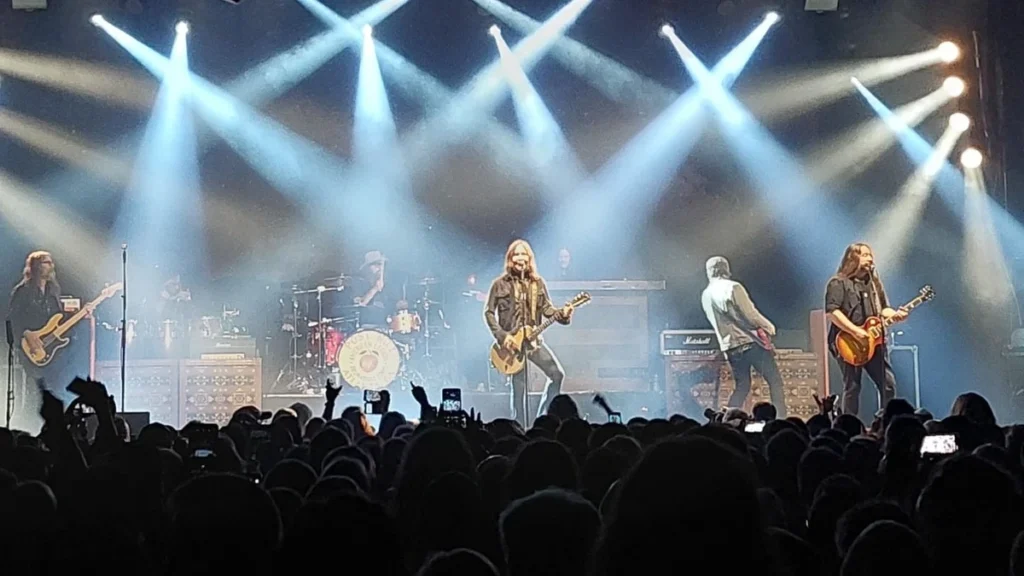
Blackberry Smoke performing in 2023.
Blackberry Smoke spent twenty-five years arriving at two nights in a former church in Nashville.
Two separate tours ran across this year, and a benefit show at home follows in November.
Two Tours in One Year
Running two named tours in twelve months is unusual and it reflects how this band works.
The first added twenty-three dates from late May, and the second added seventeen more across August and September under an anniversary banner.
Most acts tour once a year behind a record. A band that tours twice, without a new album in either case, is running a live business rather than an album cycle.
That is the defining fact about this career and it explains almost everything else about it.
Two Nights at the Ryman
The first run closed with consecutive nights at the Ryman Auditorium in Nashville on 24 and 25 July.
The Ryman is a former tabernacle with wooden pews and no amplification in its original design, and it remains one of the best-sounding rooms in American music for exactly that reason.
Two nights there is a specific marker. It is a room that holds around two thousand people and sells out on its own reputation, so filling it twice is a statement about demand rather than capacity.
What a Church Does to a Rock Show
Playing a building designed for unamplified congregational singing changes what a band can do.
The room is naturally reverberant and extremely responsive, which rewards dynamics and punishes volume. A band that plays flat out for ninety minutes sounds worse there than in a shed half its quality.
What works is what the building was built for: several voices in close harmony, and arrangements that leave space for the room to answer.
An Anniversary Without an Album
The second leg was framed around twenty-five years rather than around a release.
Anniversary touring is a legitimate format and it carries an obvious risk, since a band celebrating its own longevity is one step from becoming a heritage act.
The counterweight here is that the most recent album is recent, and that the catalogue has kept charting, which makes the anniversary a frame rather than the product.
Where the Number One Actually Was
Their 2021 album reached number one on the American Americana and folk chart, which is a more revealing detail than a general chart position would be.
That chart is not where a southern rock band is supposed to land. It measures a different constituency: roots, country-adjacent and singer-songwriter records bought by an audience that buys albums rather than streams singles.
Topping it says the band is read by the trade as a roots act, whatever the guitar volume suggests, and that reading is commercially accurate.
Southern Rock and Americana Are Not the Same
The distinction matters and is frequently collapsed.
Southern rock is a 1970s form built on twin guitars, extended solos and blues structures played loud. Americana is a much later marketing category covering roots-derived music that country radio would not play.
A band can genuinely belong to both, and this one does: the arrangements are southern rock, the audience and the retail behaviour are Americana.
The Album Chart That Still Counts
The 2024 record reached the top five on a current album sales chart, which measures purchases rather than streams.
That chart has become the most useful indicator for guitar bands, because it isolates the people who actually buy music from the far larger number who play it passively.
Acts in this field routinely outperform their streaming figures on it by an order of magnitude, and that gap is the whole economic basis of the genre.
An Independent Release
The album came out through an independent imprint rather than a major label.
For a band with this profile that is the rational structure. A major needs volume that this audience will never deliver; an independent needs a fraction of it and keeps the catalogue.
Roots and Americana artists have consequently built one of the healthier independent sectors in music, sustained by touring, physical sales and merchandise rather than by radio.
Why Roots Audiences Buy Objects
The buying behaviour is the thing that makes this sector work, and it is worth being specific about it.
This audience skews older, attends repeatedly, and buys physical media at the show rather than online. A vinyl copy sold from a merchandise table returns several times what a streamed album does and involves no intermediary.
That is why a band at this level can sustain a crew, a bus and a twenty-five-year career on numbers that would be invisible in pop.
Forty Dates in a Year
The two runs together added forty announced dates, on top of whatever else the year contained.
That is a working band’s schedule rather than an event schedule, and it is how this genre operates: the tour never really stops, it changes name.
It also means the band plays to the same regional audiences every year or two, which builds the kind of following that survives without radio.
The Markets They Actually Play
The routing runs through Davenport, Louisville and Kingston rather than through the largest cities.
Mid-sized American markets are the backbone of this circuit, and they are chronically under-served by national touring.
A band that plays them consistently accumulates an audience with very little competition, which compounds over two decades.
A Benefit Show at Home
An annual show at a venue in their home city follows in November, raising money for pediatric cancer research and family support.
Annual hometown benefits are a common structure and this one has run for years, which is the part that matters: a recurring commitment rather than a single gesture.
It also gives the band a fixed point in the calendar that is not a tour date, which for a group that tours this much is its own kind of anchor.
Twenty-Five Years With a Stable Lineup
Longevity of this kind depends less on success than on people staying in the same van.
Bands break up over money, over billing and over the accumulated friction of shared travel, and twenty-five years is well past the point where most of that becomes fatal.
Groups that survive it usually describe the same conditions: an even split, a clear division of labour, and a workload steady enough that nobody has to take another job.
Atlanta Rather Than Nashville
The band is from Atlanta and has stayed there, which is a decision with consequences.
Nashville is where the industry is, and moving there is the default for any act working in this territory. It offers writers, sessions, publishers and proximity to everybody who books anything.
Staying elsewhere costs access and buys distance from a system with a strong pull toward the middle of the road. For a band whose selling point is not sounding like Nashville, the distance is the point.
What an Anniversary Tour Has to Avoid
The format has a well-documented failure mode and it is worth naming.
An anniversary invites a set built entirely from the first three albums, played to an audience that came to remember rather than to listen. That is a pleasant evening and it converts a working band into a museum.
The alternative is to treat the anniversary as a marketing frame and play a current set inside it, which risks disappointing the people who bought a ticket for the nostalgia.
Bands that get it right usually acknowledge the occasion explicitly, play a handful of things they have not played in years, and otherwise carry on as normal. The occasion is the reason to come; it is not the show.
Why This Genre Never Depended on Radio
Understanding southern rock’s durability requires understanding what it was cut off from.
Country radio would not play it because it was too loud and not country enough. Rock radio moved on from it in the 1980s and never returned. There has been no meaningful broadcast route for this music in forty years.
What replaced radio was the road, and the genre developed accordingly: bands that tour constantly, sets built to work in front of people who have never heard the records, and audiences recruited one venue at a time.
That is a slower way to build a career and a considerably more durable one. A band that never depended on airplay cannot lose it, which is why acts in this field routinely outlast the formats that ignored them.
What Is Actually Being Tested
Two things. Whether an anniversary frame brings in anyone who was not already coming, or simply relabels a year of touring the band would have done anyway.
And whether two nights in a two-thousand-seat former church is the ceiling of this career or a room the band has finally grown into.
Twenty-five years, forty dates, two tour names, two nights in a church, and a benefit at home in November.
About The Author




More Stories
The Sound of Burlington Rock-Blues: Off the Tracks by Brian Leduke
Matt Springfield: Poplife and Its Greg Haver Sessions, Reconsidered
How FYDStar Got Scream’s Cosmic Sludge Pop Out of a Bass and Drums Duo