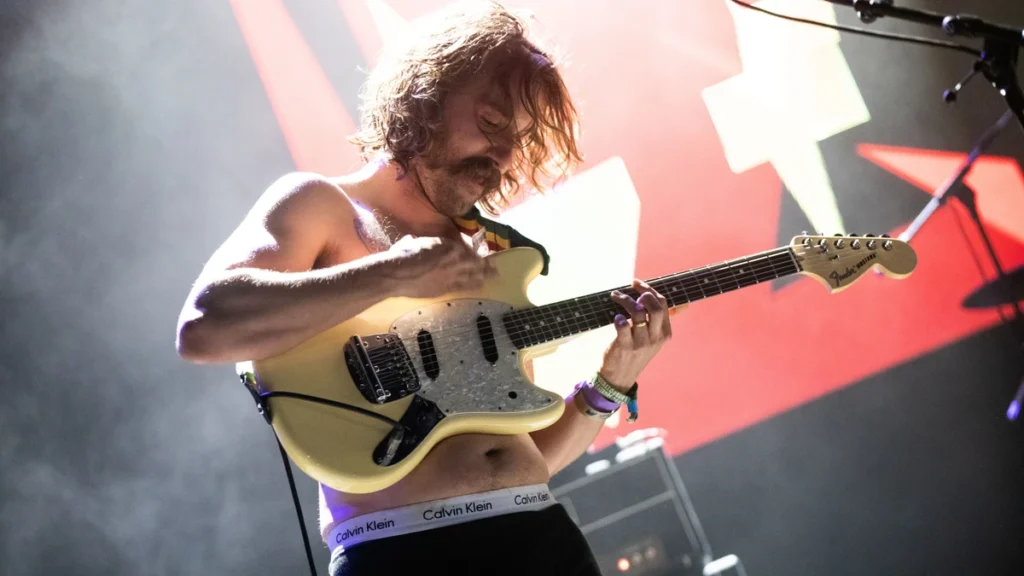
IDLES performing at Glastonbury.
IDLES open a baseball stadium in Boston on 7 September, as somebody else’s support act.
It begins an American month that also takes in two festivals and three arena dates.
A Support Slot at Stadium Scale
Opening for a larger act at a ballpark is a specific job, and it is nothing like headlining a smaller room.
The set is short, usually forty minutes. The lighting is whatever daylight is doing. Half the audience is still arriving, and none of them chose you.
What it offers in exchange is a number no headline tour at this band’s own level could reach: tens of thousands of people in one evening, most of whom have never heard the band.
Bands take these slots because the arithmetic is unanswerable, not because the experience is enjoyable.
Why Ballparks Are Difficult
Baseball grounds are among the worst-sounding venues in touring, and everybody involved knows it.
The stage goes where the outfield is, the seating was designed to face a diamond rather than a stage, and the structures were built to contain crowd noise rather than to handle amplified music.
An opening act also gets a fraction of the sound check the headliner does, which means playing a hostile room on somebody else’s settings.
Playing to People Who Did Not Come
The central problem of a support slot is indifference rather than hostility, and it requires a different response.
A hostile crowd can be won by conviction. An indifferent one has to be given a reason to look up in the first ninety seconds, which usually means opening with the loudest and most physical material available.
This is a band unusually well equipped for that, since the live show has always been built on immediate physical impact rather than on gradual development.
Three Nights With a Heavier Band
Alongside the stadium date, the run includes three shows with an American alternative metal band in Cleveland, St. Louis and Kansas City.
That is a considerably better stylistic fit than the stadium bill, since both acts trade in volume and physical intensity even though the genres are labelled differently.
Support pairings that make sense on sound rather than on chart position tend to convert far better, and touring parties generally know which of the two they are on.
Two American Festivals
The month also includes appearances at a Chicago festival and an Atlanta one.
Both are large multi-day events with bills spanning several genres, and both draw audiences who attend the festival rather than any specific act.
Festival sets are the other version of the same problem as a support slot, with the same solution: play the direct material and save the subtleties for a headline room.
Continuing an Album Cycle
None of this supports a new record. The run continues the cycle behind their fifth album, released two years ago.
Extended cycles are now standard, and they reflect a business in which touring generates the income and albums exist to justify the touring.
It also means the set has been played for a long time, which is either extremely tight or slightly tired depending on the band.
What the Fifth Album Changed
That record moved noticeably away from the sound the band was known for, softening the attack and introducing more space and more electronic texture.
Records that soften a hard sound reliably divide an audience, particularly when the hardness was part of the band’s political identity.
What it bought was room to grow. A band that only shouts has a ceiling, and the acts that cross into stadium support slots have almost always widened their range first.
Where They Came From
The band formed in Bristol and came up through the small-venue circuit over a long period rather than arriving fully formed.
Bristol has a distinct musical history built on sound systems, dub and trip hop rather than on guitar bands, which makes a loud post-punk group a slightly unexpected export.
What the city does have is a strong independent venue network, which is the actual precondition for a band developing anywhere.
What Post-Punk Means Now
The label has been applied to two distinct waves separated by forty years, which causes constant confusion.
The original was a late-1970s reaction against punk’s musical narrowness: angular guitars, prominent bass, and an interest in dub and funk rhythm rather than in speed.
The current usage covers a loose group of mostly British and Irish bands who share the spoken or shouted vocal, the repetitive rhythmic base and the willingness to sound unpleasant, which is a real family resemblance rather than a marketing term.
Speaking Rather Than Singing
The vocal approach across this scene is closer to spoken delivery than to melody, and that choice has consequences.
Spoken vocals carry lyrics far more clearly than sung ones, which is why the style suits bands with something specific to say.
It also travels badly to a stadium, where the words are the first thing lost, and it is one of the reasons this kind of band has to rework a set for a large room.
A Political Band in a Neutral Slot
This is a group with explicit politics, playing to crowds that did not select them for it.
That produces a real decision every night: deliver the material as written, or soften the framing for an audience that came for something else.
Bands that soften it are generally found out, and bands that do not occasionally lose a room. Either way it is a live choice rather than a recorded one.
Community as a Live Strategy
The band’s live reputation rests on audience participation, on a stated ethic about looking after each other in the crowd, and on a frontman who talks between songs.
All of that is easy to sustain in a room of eight hundred and extremely difficult at ten thousand, let alone in a ballpark.
The bands that manage it usually do so by shrinking the address rather than scaling it, talking to the front rows as though the rest were not there.
British Dates Before America
The North American month follows British shows in late August, including two consecutive London nights.
Two nights in one city is a demand signal and a scheduling efficiency, since the production is built once and used twice.
It also lets a band play a longer, stranger set on the second night for an audience that attended both, which is a small reward for the people who follow closely.
What a Support Tour Actually Costs
The economics of opening for a stadium act are worse than the exposure suggests, and it is worth being specific.
Support fees at that level rarely cover the cost of being there. The band still pays for a crew, transport, accommodation and freight, and receives a flat sum negotiated against a headliner with all the leverage.
Merchandise is where the money is, and it is also where the headliner’s venue deal takes a percentage. A support act frequently comes off a stadium run having lost money in exchange for the audience it gained.
The bet is on conversion: that some fraction of those tens of thousands buys a ticket to a headline show eighteen months later at a venue the band could not previously fill. That bet is unmeasurable in advance and occasionally wrong.
Why This Scene Reached America at All
The current wave of British and Irish post-punk has done unusually well in the United States, which was not obvious in advance.
The music is verbal, regionally specific and frequently concerned with British social conditions that do not translate directly. On paper it should have stayed a domestic phenomenon in the way several previous British scenes did.
What travelled instead was the delivery. A shouted vocal over an insistent rhythm reads as urgency in any language, and the live shows are physical in a way that requires no context to understand.
That is also why the stadium support slot is a coherent booking rather than an odd one. What works on a festival crowd who cannot hear the words is exactly what works on fifty thousand people waiting for somebody else.
What Is Actually Being Tested
Two things. Whether a band built on proximity and audience participation can transmit any of that from a stage in an outfield.
And whether a support run at that scale converts into headline ticket sales later, which is the only justification for taking it.
One ballpark, three arena nights, two festivals, forty minutes at a time, and an audience that came for somebody else.
About The Author

More Stories
The Sound of Burlington Rock-Blues: Off the Tracks by Brian Leduke
Matt Springfield: Poplife and Its Greg Haver Sessions, Reconsidered
How FYDStar Got Scream’s Cosmic Sludge Pop Out of a Bass and Drums Duo