




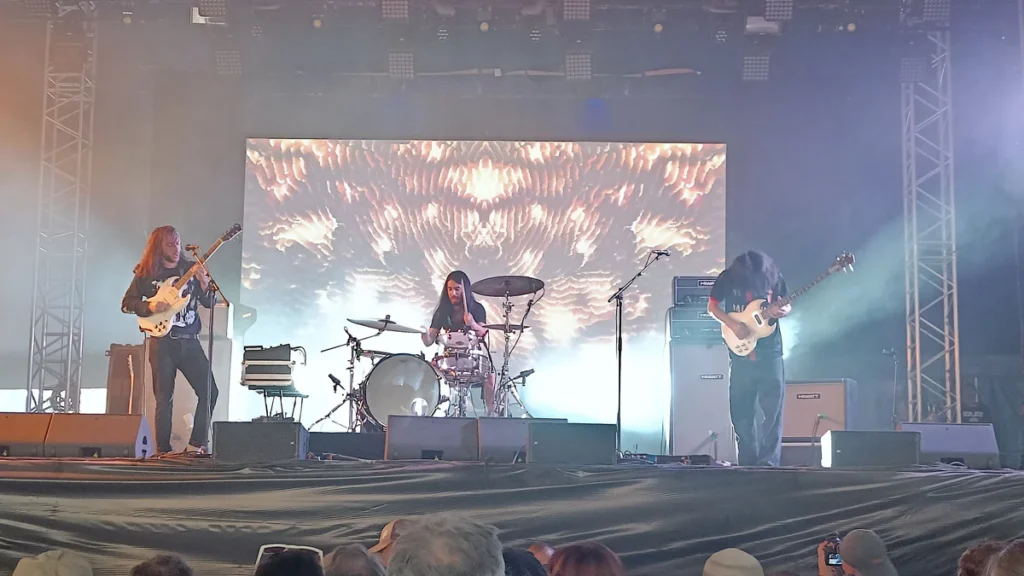
Slift performing at Motocultor in 2026.
Slift released their fourth album through Sub Pop in June and tour three continents between October and December.
The French trio close in London four days before Christmas week.
A Seattle Label for a Toulouse Band
Sub Pop signing a French psychedelic trio is a less obvious pairing than it appears.
The label’s identity was built on a specific American scene in a specific decade, and its subsequent roster has been overwhelmingly Anglophone.
What it has consistently done is sign bands that are loud and strange rather than commercially obvious, which is a better description of its actual pattern than the grunge history it is remembered for.
For a European band, an American independent with that reach solves the single hardest problem in the genre: getting the records into shops on the other side of an ocean.
What the Label Said About It
The label’s description of the record frames it around trusting in some hidden power and believing in a world nobody can yet articulate, while noting that the band remains loud, heavy and aggressive inside those songs.
That combination is the interesting part. Psychedelic music has a long association with retreat, and a record built on holding a belief rather than escaping is a different proposition.
The band’s own announcement carried the same tension, framing a tour around reality collapsing and ending on the phrase one love for the world.
Long Pieces Rather Than Songs
The band works in extended forms, and that is a structural choice rather than an atmospheric one.
A four-minute psychedelic song is a texture applied to a pop structure. A twelve-minute one has to be built: it needs sections, a development, a point where the material changes and a reason for that change to arrive when it does.
That construction is progressive rock’s central technique, whatever the surface sounds like, and it is why bands in this territory sit in both categories without contradiction.
How a Riff Becomes a Structure
The method these bands use is worth setting out, because it is not improvisation.
A figure is stated and repeated past the point of comfort, which shifts the listener’s attention from the notes to the texture around them. The band then changes one variable at a time: the drums double, the bass moves, a second guitar enters an octave up.
Because nothing changes suddenly, the piece can travel a very long way from where it started without any single moment feeling like a transition. That is a compositional discipline, and it is much harder to sustain than a verse and chorus.
The failure mode is equally specific. A section held too long without a variable moving stops being hypnotic and becomes tedious, and the difference between the two is often thirty seconds.
A Trio Playing Heavy Music
Three musicians is the smallest configuration that can sustain this music, and it shapes everything.
With one guitar there is no harmonic safety net: the moment the guitarist plays a lead line, the harmony is carried entirely by the bass, which has to be far more melodically active than in a four-piece.
Trios that work in this idiom therefore tend to have bass players doing something closer to a second guitar part, and drummers who fill space a rhythm guitarist would otherwise occupy.
Nineteen Days in North America
The American leg runs from 6 October in Boston to 24 October in Los Angeles.
Nineteen days coast to coast is a compressed schedule, and it is the standard shape for a European band’s first substantial American run: hit the markets that will sell, cover the distance, leave.
Clubs of the size they are playing are the right scale for this. A psychedelic trio needs a room where volume is physical rather than merely loud.
Opening the European Leg at Home
The European dates open on 17 November in Toulouse, which is where the band is from.
Starting a continental tour in your own city is unusual, since a hometown show is normally saved for the end as a celebration.
Opening there instead makes it a rehearsal in front of the most forgiving audience available, which is the more practical use of it.
French Rock and the Export Problem
French bands have historically found it difficult to export rock music, and the reasons are structural rather than musical.
Domestic radio quotas favour French-language music, which supports a healthy internal market and produces artists whose careers do not require export.
Instrumental and largely wordless music sidesteps that entirely, which is one reason France’s most internationally successful rock exports have tended to be electronic or heavily instrumental.
Ending in London
The British and Irish dates run from Dublin on 8 December to a London hall on 13 December.
December touring is unfashionable, since audiences are spending money elsewhere and every venue is competing with Christmas programming.
The compensating advantage is an almost empty calendar in the weeks before, which for a band without radio support is worth more than a better month with more competition.
Playing Metal Festivals
The band appears on festival bills that are substantially heavier than their genre label suggests.
Heavy psych occupies a useful position between scenes: loud enough for a metal audience, strange enough for a psychedelic one, and instrumental enough to require no shared language.
Bands that can play both circuits effectively double their available bookings, which is a significant advantage in a genre with no radio presence.
Why Instrumental Music Travels
A largely wordless band has an advantage in international touring that is rarely stated plainly.
There is nothing to translate. An audience in Boston, Toulouse or Dublin receives exactly the same performance, and none of them is at a disadvantage.
The trade is that a band without lyrics gives up the most direct route to an audience’s attachment, and has to build it entirely through sound and physical presence instead.
Science Fiction as a Frame
The band’s imagery and titles draw consistently on science fiction, which is a long-standing convention in this music.
The link is not decorative. Both psychedelic and progressive rock have used speculative settings for the same reason: they license structures and durations that a realistic subject would not support.
A song about a journey can take twelve minutes without anybody asking why. The frame buys the form.
What a Fourth Album Has to Do
By a fourth record a band in this genre has established its method and faces the specific problem that method creates.
The audience arrived for a sound, and reproducing it exactly is the safe choice that eventually kills interest. Departing from it risks the following that took three albums to build.
Signing to a larger label at the same moment sharpens that, because a new audience is arriving with no attachment to the previous three records at all.
What Sub Pop Actually Provides
The practical value of that deal is worth explaining, since label signings are usually reported as prestige.
Distribution is the substance of it. A European band self-releasing can reach American listeners through streaming and can sell almost no physical stock there, because getting records into American shops requires a distributor with existing relationships.
For a genre whose audience buys vinyl at a rate the wider industry no longer sees, that gap is the difference between a touring hobby and a career.
The label also supplies the thing money cannot buy quickly: a name that American promoters and press already trust, which turns a booking request from an unknown French trio into one from a Sub Pop band.
Three Legs in Three Months
Compressing North America, continental Europe and Britain into October, November and December is aggressive scheduling for a three-piece.
Small bands do it because the alternative is spreading the same dates across a year and paying to set up the touring operation three separate times.
The cost is physical. Three legs back to back with an ocean in the middle is close to the maximum a band at club level can absorb without something breaking, and it is usually the reason a band takes the following year off.
What Is Actually Being Tested
Two things. Whether long-form instrumental music built on repetition holds a room in three continents where nobody shares a language with the band.
And whether an American label’s distribution turns a European club act into one that can fill the same rooms next time without the tour paying for the introduction.
One fourth album, one Seattle label, nineteen days across America, and a London hall in the middle of December.
About The Author




More Stories
The Sound of Burlington Rock-Blues: Off the Tracks by Brian Leduke
Matt Springfield: Poplife and Its Greg Haver Sessions, Reconsidered
How FYDStar Got Scream’s Cosmic Sludge Pop Out of a Bass and Drums Duo