


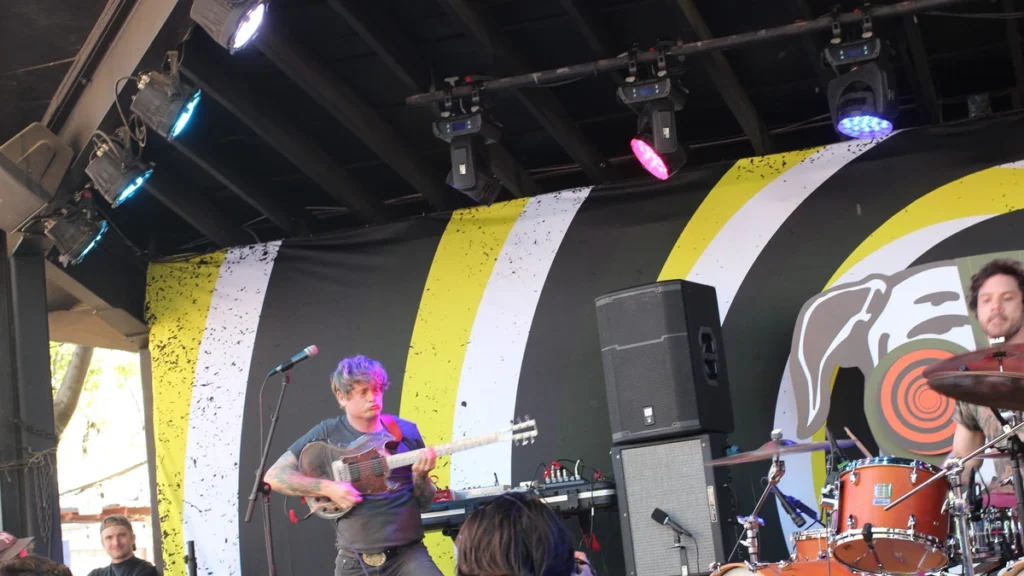
Osees performing under their earlier name Thee Oh Sees.
Osees released an album in June without telling anybody it was coming.
It came out of jam sessions rather than songs, and it is not the only thing they put out this year.
A Release With No Campaign
Surprise releases are usually the preserve of artists large enough that the surprise is itself the promotion.
At this level it works differently. A band with a committed, closely-following audience does not need a six-week campaign, because the people who will buy the record find out within hours regardless.
What it saves is the machinery: no lead single, no announcement cycle, no pre-order window, no embargoed reviews.
What it costs is everything that machinery buys, which for most artists is the only route to anyone outside the existing audience.
Made From Jams Rather Than Songs
The record is described as coming from loose, free-associative sessions, which is a specific compositional position.
Music built from jamming has a different shape from music built from writing. Sections last as long as the players sustained them, transitions happen where somebody moved first, and the arrangement is a record of a decision made in real time.
Editing is where such records are actually made. Hours of playing become forty minutes through choices about where to cut, which is closer to documentary assembly than to composition.
Why Improvised Records Can Fail
The failure mode is well understood and worth naming.
A jam is far more interesting to play than to hear, because the players are responding to each other in real time and the listener only receives the result.
Records that survive the transfer usually do so because somebody was ruthless afterwards, discarding the passages that were exciting to be inside and dull to be outside.
Three Releases in Two Years
This follows an album last year and a surprise EP, alongside a live album and a film soundtrack.
That output rate is unusual now and was normal for most of recording history, when bands released two albums a year as a matter of course.
What makes it possible is a fixed band, an owned studio and a label relationship that does not require a marketing plan for every release.
A Live Album From a Museum
They also released a recording made at an art museum, with a full accompanying video performance.
Playing a museum rather than a club changes what a band can do: the room is quiet, seated or standing still, and the audience is disposed to watch rather than to move.
For a band whose live reputation is built on volume and physical chaos, that is close to an inversion, and it is why the recording exists as a separate document.
A Stop-Motion Film Alongside
The band’s frontman also released a stop-motion short film with its own soundtrack.
Stop-motion is among the most labour-intensive forms available, requiring thousands of individual adjustments for a few minutes of footage.
An output rate like this band’s usually indicates somebody who works constantly rather than in cycles, and a hand-animated film is fairly conclusive evidence of that.
Four Nights in One San Francisco Room
The August dates include four consecutive nights at the same San Francisco venue.
A four-night residency in a mid-sized club is a specific kind of statement. It requires an audience willing to attend more than once, which in turn requires the sets to differ.
It is also the band’s home city, and multi-night home stands are the clearest measure of a local following that exists.
Two Nights in Brooklyn
The October leg includes two nights at a Brooklyn venue alongside dates in Chicago and Austin.
Splitting the American touring into a West Coast August and an East Coast October rather than one continuous run is a scheduling choice that suits a band with other projects.
It also avoids the worst of both climates, which for a band playing hot, crowded rooms is not a trivial consideration.
A Post-Punk Band on Every Date
A Los Angeles post-punk group supports every North American show.
Carrying one act across an entire run rather than rotating openers is the older model, and it builds something a rotating bill cannot: a support band that measurably improves across six weeks.
The pairing is also stylistically coherent, which matters more to this audience than a bigger name would.
Where the Post-Punk Actually Is
This band is filed as garage and psychedelic rock, and the machinery underneath is substantially post-punk.
The rhythmic engine is motorik: a fast, even, unaccented pulse borrowed from German bands of the early 1970s, which post-punk absorbed and made standard.
What it does is remove swing entirely. There is no push or pull in the beat, which stops the music feeling like rock and roll and starts it feeling like a machine, and it is why the long passages are hypnotic rather than merely fast.
Two Drummers
The band has spent long periods with two drummers playing simultaneously, which is an unusual configuration outside jazz and afrobeat.
The point is not volume. Two kits playing an identical part produce a thickness and a very slight timing spread that one player cannot generate, and the result sits somewhere between a drummer and a loop.
That is a direct extension of the motorik idea, and it is the most audible piece of post-punk construction in a band otherwise described as psychedelic.
Changing the Name Repeatedly
The band has operated under several variations of the same name across two decades.
Renaming repeatedly is commercially unhelpful, since it fragments a catalogue across search results and streaming profiles.
Bands who do it anyway are usually signalling that the project is a continuing practice rather than a brand, which is consistent with the release rate.
Owning the Means of Release
The label infrastructure around this band is largely self-operated, which is what makes the pace possible.
An artist releasing through somebody else’s label has to fit a schedule, a marketing calendar and a queue of other releases. An artist releasing through their own can put a record out the week it is finished.
The trade is reach. Self-release means no promotional department and no radio push, which is only viable when the audience already knows where to look.
Why Surprise Releases Work Here and Not Elsewhere
The mechanics are worth setting out, because the tactic fails for most artists who try it.
A surprise release converts an existing audience efficiently and reaches nobody new. There is no window for press, no lead time for playlist consideration, and no way for an algorithm to build anticipation it was never told about.
For an artist whose growth depends on discovery, that is close to self-sabotage. For one whose audience is already assembled and attentive, it removes months of work with no measurable loss.
The deciding factor is not fame but attention density: whether enough people are watching closely enough that the news travels without being pushed. A band twenty years into a catalogue with a devoted following has that; a band on its second album does not.
What a Prolific Catalogue Does to a Listener
Two decades of releases at this rate creates a problem the band seems untroubled by.
The catalogue is now large enough that no casual listener can approach it. There is no obvious entry point, the records vary substantially, and the sheer number implies a commitment most people will not make.
The compensating effect is that the audience which does engage treats the discography as a continuing body of work rather than a series of products, and turns up for each new instalment without needing to be convinced.
That is a smaller audience and a considerably more durable one, and it is the only foundation on which a release schedule like this could survive.
What Is Actually Being Tested
Two things. Whether a record made from jams survives the edit into something worth hearing rather than a document of a good afternoon.
And whether releasing constantly, with no campaign around any of it, builds a body of work or simply produces more of it.
One surprise album, one live record, one stop-motion film, four nights in San Francisco, and no announcement for any of it.
About The Author



More Stories
The Bowie Cover Def Leppard Played Before Every Show Is Now a Single
The Sound of Burlington Rock-Blues: Off the Tracks by Brian Leduke
Matt Springfield: Poplife and Its Greg Haver Sessions, Reconsidered