




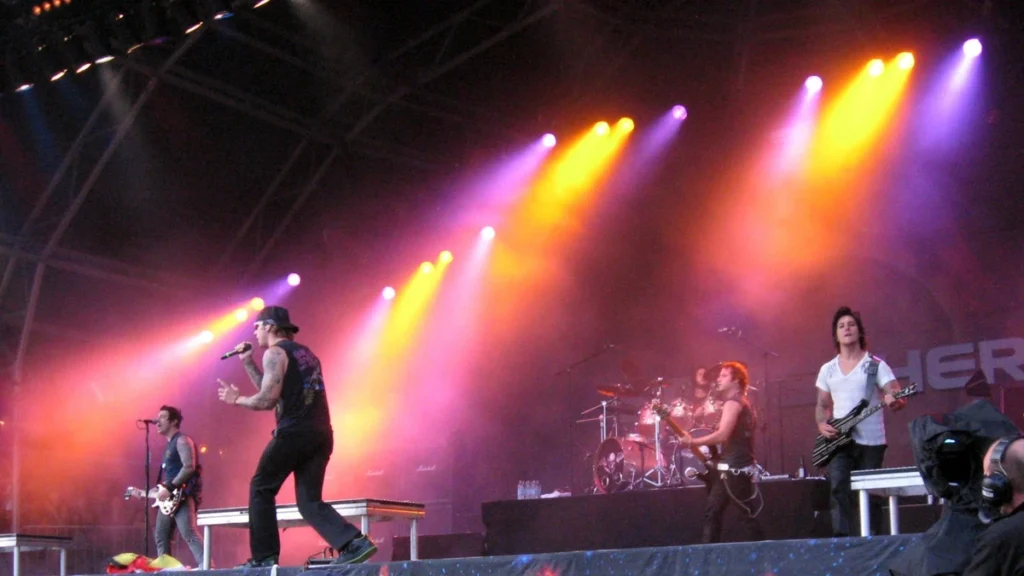
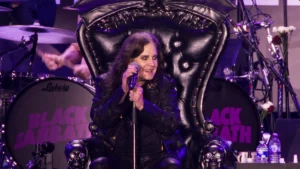
Avenged Sevenfold performing at a festival.
Avenged Sevenfold close a seventeen-city summer run on 30 August at a Los Angeles stadium holding around twenty-four thousand.
It is the last date of a co-headline tour rather than a support bill.
Co-Headlining Is Not Sharing
A co-headline tour is a specific commercial arrangement and it differs meaningfully from a headliner with support.
Both acts are billed equally, the revenue split is negotiated rather than a flat fee, and the running order frequently alternates by market according to which band sells better locally.
It works when two acts have comparable draw and only partially overlapping audiences, so the combined bill sells rooms neither could fill alone.
It fails when one act is clearly larger, at which point the smaller one is a support act with a better contract.
Two Bands From Different Scenes
The pairing here brings together a metalcore-derived band and one that came out of pop punk, which is a wider gap than the shared decade suggests.
Both emerged in the early 2000s and both reached mainstream audiences, but through different radio formats and different magazine covers.
The audiences are now roughly the same age, which is the actual logic of the bill: it is a demographic pairing rather than a stylistic one.
Finishing in Los Angeles
The last date is in the band’s home region, which is a conventional and effective way to end a run.
Home-market finales sell on the occasion as much as the performance, and they allow guests, extended sets and a production that does not have to be struck and moved the next morning.
Adding a third band for that date only makes it more clearly an event rather than a tour stop.
A Stadium Rather Than an Arena
Twenty-four thousand is a football stadium rather than a basketball arena, and the difference matters more than the numbers suggest.
Arenas are enclosed, acoustically predictable and designed for amplified sound. Stadiums are open, subject to weather and curfews, and require a substantially larger sound system to cover.
Booking one for a single night rather than as part of a stadium tour means paying the full production cost for one show.
Seventeen Cities in a Summer
Seventeen dates across a summer is a moderate run by rock touring standards, spread rather than dense.
The routing took in Toronto, Montreal, Tampa, Dallas and Denver, which is a spread across the continent rather than a regional cluster.
Runs of that length tend to indicate a tour built around amphitheatres and festival slots rather than a full national campaign.
Three Years Since the Album
Their most recent studio album came out in 2023, which makes this the third year of touring behind it.
Long cycles are standard at this level, and they reflect a live business that no longer depends on a release schedule to generate demand.
It also means the audience is buying the catalogue rather than the record, which changes what a set list has to do.
A Single in December
A track released in December has been played live on this run, giving the shows something the previous years did not have.
Releasing a single without an album attached is now routine, and it functions as a way of keeping a touring act present without committing to a full campaign.
What it does for the live show is more practical: it gives the band one song the audience has not heard hundreds of times.
An Album That Divided the Audience
The 2023 record moved substantially away from the sound the band was known for, incorporating structures and textures from outside heavy music entirely.
Records of that kind reliably split an audience, and the split is usually generational within the fanbase rather than between fans and critics.
Touring it for three years is itself an answer to that argument, since the shows have continued to sell.
Changing Direction Late
Bands that alter course eight albums in are doing something genuinely risky, and most do not.
The safe path is well understood: keep making the record that worked, tour it, and accept slowly declining returns in exchange for stability.
The alternative trades part of the existing audience for the possibility of a different one, and the outcome is rarely clear for several years.
From Huntington Beach
The band came out of coastal Southern California, from a scene that produced a substantial number of bands in the same period.
Regional clusters of that kind are common in heavy music, and they usually depend on a small number of venues, a local promoter and a skate or surf culture that supplies the audience.
Almost all of those scenes have since been priced out of the places that produced them.
Metalcore Reaching the Mainstream
The genre they emerged from was a subculture in 2001 and a commercial force by 2007, which is an unusually fast transition.
What drove it was the combination of aggressive verses with melodic choruses, which turned out to be radio-compatible in a way pure heavy music was not.
The bands who made that transition are now the heritage acts of the format, headlining stadiums to audiences who were teenagers when it happened.
Nostalgia Bills and Their Limits
A co-headline tour of two bands from the same era is unavoidably partly a nostalgia proposition.
The format works well and has an obvious ceiling, since an audience buying a memory will do it once every few years rather than annually.
Bands who rely on it exclusively find the returns declining, which is the argument for continuing to release music nobody strictly needs.
Adding a Third Band for One Night
Bringing in an additional act for the final show is a small piece of event engineering.
It differentiates the date from the sixteen that preceded it, which matters when a fan could have seen the same bill in another city two weeks earlier.
It also broadens the ticket-buying audience for the one show that carries the largest capacity and therefore the largest risk.
How a Co-Headline Deal Actually Works
The mechanics are worth setting out because the billing conceals most of what is negotiated.
The two acts agree a split of the net after costs, typically weighted toward whoever is judged the stronger draw, and that weighting is argued over using historical ticket data city by city.
Running order is separately negotiated. Closing the show is worth more in prestige and less in practice, since a substantial portion of a stadium audience leaves before the final three songs to beat the traffic.
Production is where the real tension sits. Two headliners both want a full stage set, and the changeover between them has to happen in front of a paying audience, which is why co-headline tours frequently run leaner productions than either band would mount alone.
What a Third Year of Touring Costs
Touring one album for three years has a specific effect on a band that is rarely discussed.
Set lists calcify. By the third year the show is optimised, every transition is rehearsed, and the band is executing rather than discovering, which audiences generally cannot detect and musicians consistently report.
It also delays the next record. Writing on the road is possible but produces a particular kind of material, and most bands need a genuine stop to make something different.
The counter-pressure is financial. A tour that still sells is difficult to walk away from, and the album that follows a three-year cycle is usually late, expensive and carrying a great deal of expectation.
What Is Actually Being Tested
Two things. Whether a co-headline bill of two bands from the same era fills a stadium on its own, without a festival or a new record behind it.
And whether a band three years past an album that split its audience is touring on momentum or on genuine current demand.
Seventeen cities, two headliners, one stadium in Los Angeles, and a single from December to close the set.
About The Author


More Stories
Matt Springfield: Poplife and Its Greg Haver Sessions, Reconsidered
How FYDStar Got Scream’s Cosmic Sludge Pop Out of a Bass and Drums Duo
Overcome by FISTFIGHT HXC, Reconsidered: Regina Hardcore with a Thrash Pulse