



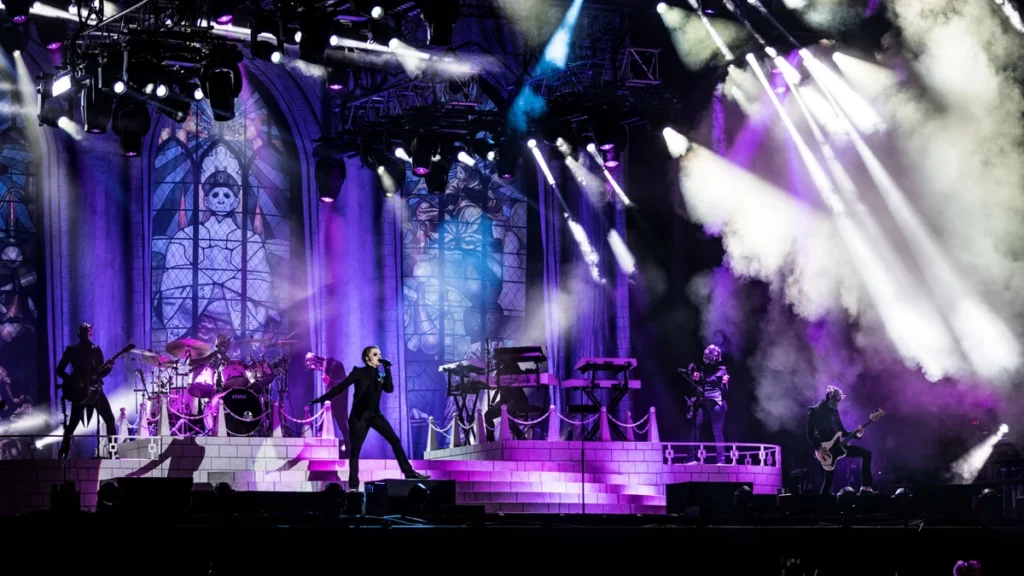
Ghost performing at Wacken Open Air in 2018.
Ghost‘s Tobias Forge has said he will step away from touring once the current cycle finishes, at the most commercially successful point of the band’s existence.
The last leg ended in Los Angeles in February.
Stopping at the Top
The timing is the unusual part. The album behind this tour entered the American chart at number one, and the touring filled arenas.
Acts almost never stop at that point, because the machinery around a band at peak demand is substantial and everybody employed by it has an interest in continuing.
What makes it possible here is that the decision belongs to one person rather than to a four-way partnership, which is a structural feature of this particular band.
He has been explicit that this is a pause in touring rather than an ending, which is a distinction worth taking at face value.
The Reason He Gave
His stated reason is domestic: that physically and mentally he needs to be at home, and that his children are seventeen and will not be there much longer.
Musicians rarely say this publicly, partly because it reads as unglamorous and partly because the industry has historically treated it as a lack of commitment.
Saying it plainly, at a commercial peak, is the version of that statement with the most credibility and the least to gain.
What Touring Actually Costs
Arena touring is frequently discussed as a reward and rarely as a job with specific physical demands.
A run of that scale means several months of consecutive travel, performing at full exertion every second night, sleeping in transit and eating on a schedule dictated by load-in times.
Performers in their forties and fifties describe the recovery time between shows lengthening year on year, which is the practical version of the statement he made.
A Band Built Around a Character
The project is unusual in that its frontman performs as a costumed character rather than as himself, backed by masked musicians.
That structure was designed for anonymity and it produced something more useful: a band whose visual identity is entirely separable from the people performing it.
It also means the audience’s relationship is with a persona, which changes what a break means.
Masks and What They Allow
Anonymous musicians can be replaced without the audience noticing, which is a genuine operational advantage and a well-documented feature of this band.
It removes the problem that ends most groups, which is that one member’s availability constrains everybody’s.
What it does not solve is the frontman, since the character is written and performed by one person and cannot be recast without becoming a different thing.
The Production Is the Point
The live show is built around a full stage set, costume changes and a cathedral-styled construction that travels with the tour.
Productions of that kind cost a great deal to build and more to move, which is why they only exist above a certain ticket volume.
It also means a touring hiatus idles a substantial physical asset, and those sets are rarely reused after a cycle ends.
Theatre in Heavy Music
Costume and character have a long history in this genre and a poor reputation outside it.
The objection is that theatre substitutes for musicianship, which is easy to say and difficult to sustain in the face of acts who do both.
What the theatrical approach reliably provides is a show that works at arena distance, where facial expression and instrumental detail are invisible and staging is all the audience has.
A Number One in a Difficult Market
The album entered the American chart at number one on roughly eighty-six thousand equivalent units.
That figure would have been unremarkable twenty years ago and is a strong result now, which says more about the market than about the record.
Heavy music charts well on release week because its audience buys physical copies, and this is one of the clearer demonstrations of that.
Five Weeks of Arenas
The 2026 leg ran from 21 January in Orlando to 23 February in Los Angeles.
Five weeks is a compact American run, and a January start is unusual, since most touring avoids the weeks after Christmas.
Ending at a newly opened Los Angeles arena rather than in a traditional market is consistent with a band that has moved into the venue tier above theatres.
Working on Other Things
He has described film projects in progress and recording with something other than this band.
Artists stepping back from a successful project almost always have other work waiting, and the framing matters: a break to do something else reads differently from a break to do nothing.
He has also been clear that what he is working on is neither an EP nor the next record under this name.
Appearing on Somebody Else’s Anniversary
He is among a large group of guests on a German metal band’s fiftieth-anniversary re-recording project.
Multi-guest anniversary albums are a well-established format and usually a straightforward exercise in mutual promotion.
They are also close to the only remaining mechanism by which musicians across a genre appear on a record together.
Swedish Metal’s Second Wave
The band came out of Sweden, which has produced an improbable quantity of internationally successful heavy music for a country of its size.
The usual explanation is municipal music education, subsidised rehearsal spaces and a small enough scene that everybody plays in several bands.
Whatever the cause, the output has been consistent for thirty years across several distinct subgenres.
What a Hiatus Does to Momentum
Stepping away at a peak carries an obvious commercial risk, and the history is mixed.
Some acts return to a larger audience, having become scarce. Others find the audience has moved, particularly if the gap runs past three or four years.
What appears to predict the outcome is whether the artist remains visible in some form during the break, which the film and recording work would provide here.
Why One-Person Bands Can Stop
The decision structure of this project explains why the announcement could be made this way.
In a conventional band, stopping touring is a negotiation between several people whose incomes and identities are bound to the same enterprise, and someone always wants to keep going.
A project written, directed and fronted by one person with hired musicians has no such negotiation. The person who decides is the person who bears the cost of continuing.
That is the same structure that lets the band replace players invisibly, and it cuts both ways: total creative control also means there is nobody to carry the load when the person at the centre needs to stop.
The Part of Touring Nobody Photographs
The gap between how touring looks and what it consists of is worth stating, because it is the actual content of his announcement.
A show occupies perhaps two hours of a day. The remaining twenty-two are travel, waiting, press, soundcheck and the specific fatigue of being somewhere unfamiliar every morning for three months.
For a performer in costume the day is longer still, with makeup and wardrobe adding hours at both ends, and no possibility of walking out of the venue between them.
Musicians who quit touring almost never cite the shows. They cite everything around the shows, which is the part that does not appear in any photograph of the job.
What Is Actually Being Tested
Two things. Whether a band built on a character rather than on personalities can pause without the audience drifting, since the character does not age or tire in the way a person does.
And whether stepping away at a commercial peak is a career risk or the only point at which it can be done from a position of strength.
One number one album, five weeks of arenas, a stage set with nowhere to go, and a frontman who says he wants to be at home.
About The Author

More Stories
Matt Springfield: Poplife and Its Greg Haver Sessions, Reconsidered
How FYDStar Got Scream’s Cosmic Sludge Pop Out of a Bass and Drums Duo
Overcome by FISTFIGHT HXC, Reconsidered: Regina Hardcore with a Thrash Pulse