




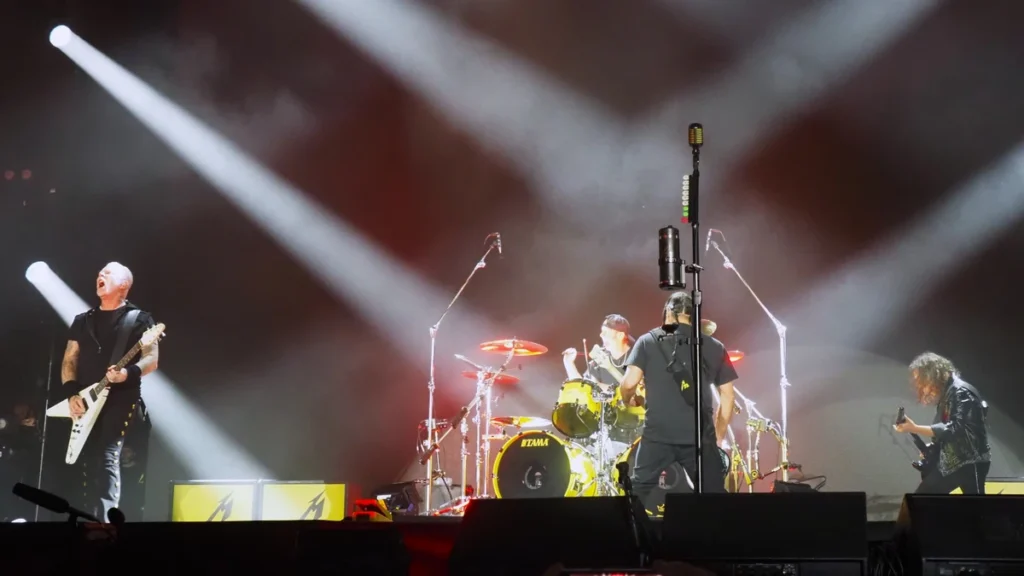
Metallica performing at Marvel Stadium in 2025.
Metallica open a twenty-four night residency at Sphere in Las Vegas on 1 October, running in blocks until March.
The two shows of any weekend share no songs.
What No Repeat Actually Requires
The format sounds like a marketing line and is a substantial operational commitment.
Two entirely distinct sets means roughly forty songs rehearsed to performance standard rather than the twenty a conventional tour needs.
It also doubles the production work, because at this scale every song has its own lighting cues, video content and pyrotechnic timings, all programmed in advance and triggered to the performance.
A band running two sets is therefore carrying two shows, and the crew is rebuilding the programming between Thursday and Saturday.
Why Bands Avoid It
The reason no-repeat formats are rare is risk rather than effort.
A fixed set is refined over months until the transitions, the pacing and the technical cues are reliable. Playing a second set means half the material is being performed far less often and is correspondingly less secure.
For a band whose catalogue runs to four decades, the compensating advantage is that there is enough material to fill two nights without reaching for songs nobody wants.
Twenty-Four Nights in One Room
The residency runs from October into November, pauses, and resumes from late January to mid-March.
Splitting a residency into blocks with a long gap is standard, since twenty-four consecutive weeks in one city is more than any audience or band can sustain.
It also allows the production to be struck and the venue to be used by others during the gap, which is how these arrangements are actually scheduled.
Growing From Eight to Twenty-Four
The run was announced as eight dates and expanded three times.
Staged announcements are deliberate. A residency that sells out and then adds dates generates several news cycles from one booking, and it avoids the appearance of a slow-selling run.
The alternative, announcing twenty-four at once, risks visible unsold inventory, which is far more damaging than a sold-out eight that grows.
A Venue Built for Something Else
Sphere was designed around a wraparound interior video surface, which is the reason acts book it and the main problem it presents to a rock band.
The venue’s other residencies have leaned on that surface, using it to place audiences inside constructed environments rather than to show a band playing.
A four-piece with a fixed stage and a drum riser has to decide whether it is competing with the screen or using it.
What a Screen Does to a Rock Show
The risk with a venue of this kind is that the visuals become the performance and the band becomes incidental.
Audiences at immersive venues consistently report watching the room rather than the stage, which is a reasonable response to what the room cost to build.
The bands who solve it generally do so by keeping the visual content abstract during the songs and saving the spectacle for moments where nobody is playing anything intricate.
Residencies as a Business Model
The economics of a residency are close to the inverse of a tour and considerably more favourable.
The production is built once and never moved, there is no freight, no routing, and no travel days, and the crew stays in one city for months.
What the artist gives up is the ability to reach an audience where it lives, replaced by requiring the audience to travel to them.
Making the Audience Come to You
That trade only works for acts whose audience will fly, and Las Vegas exists partly to service it.
The city has the hotel capacity, the flight connections and the established habit of travelling for entertainment, which no other American market matches.
For an international band it also concentrates a global audience into one venue rather than requiring twenty dates across a continent.
The Format Came From the Tour
The no-repeat idea is carried over from the band’s ongoing world tour, which has used two-night stands with distinct sets and supporting acts.
That structure was itself a response to stadium economics: two nights in one stadium is cheaper than one night in two, and the second night sells to people who attended the first.
Transplanting it into a residency is a logical extension, since a resident production makes the second set cheaper still.
Four Decades of Catalogue
Forty songs across two nights is only possible with a very large body of familiar material.
Most bands, including successful ones, have perhaps twenty songs an audience genuinely wants, which is exactly one set.
A catalogue deep enough to fill two without repetition is a specific asset that takes decades to accumulate and cannot be bought.
Selling Out Before the First Night
All twenty-four dates sold before the residency opened, which is the clearest measure of demand available.
Selling a venue of that size twenty-four times over in a single city is a different achievement from selling twenty-four different cities once each.
It requires an audience willing to travel, which is a smaller and wealthier group than the one that buys a ticket in its home town.
What Happens to a Band in Residency
Extended residencies change how a band plays, and the reports are consistent across genres.
The room becomes known within a few nights, the sound stops being adjusted, and the players stop compensating for unfamiliar acoustics.
What follows is either a band taking risks it would not take on tour, or one settling into a routine, and which of those happens is largely down to whether the set changes.
Why This Band and Not Others
Very few rock acts could fill this booking, and the reasons are structural rather than about quality.
It requires a global audience, a catalogue of forty familiar songs, the production budget to build two shows, and a name that sells a destination trip.
The list of bands meeting all four conditions is short enough to name in a sentence, which is why residencies at this scale keep going to the same handful of acts.
The Real Cost of Two Sets
The doubled workload falls unevenly, and it lands hardest on people whose names are not on the ticket.
The band rehearses twice the material, which is demanding but is also the job. The production crew has to build, program, test and maintain two complete shows, then switch between them on a two-day turnaround, twelve times.
Lighting and video are the pinch point. Every cue is timed to a performance, and a song played on Thursday but not Saturday still has to sit ready in the system without interfering with Saturday’s programming.
That is why no-repeat formats are announced by artists and quietly dreaded by crews, and why they appear almost exclusively on runs where the production sits in one building.
What an Immersive Venue Rewards
Sphere has now hosted enough residencies to see which approaches work, and a pattern has emerged.
Acts that treat the surface as a giant television, showing the band larger, waste it. The screen is at its most effective when it changes the apparent shape of the room, which is a thing no other venue can do.
The counter-risk is that a fully immersive visual show reduces the musicians to a soundtrack, which suits some acts and is fatal for a band whose appeal is four people playing.
The likely compromise is the one most rock acts reach: an abstract environment for most of the set, and two or three moments where the room becomes something else entirely.
What Is Actually Being Tested
Two things. Whether a no-repeat format survives twenty-four nights, or quietly becomes two fixed sets alternating.
And whether a band whose appeal is four people on a stage can hold a venue built to make the stage the least interesting thing in the room.
Twenty-four nights, two sets, one room, and a screen that cost more than the tour.
About The Author


More Stories
Matt Springfield: Poplife and Its Greg Haver Sessions, Reconsidered
How FYDStar Got Scream’s Cosmic Sludge Pop Out of a Bass and Drums Duo
Overcome by FISTFIGHT HXC, Reconsidered: Regina Hardcore with a Thrash Pulse