






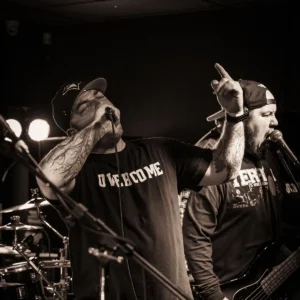
Eric Gales performing, playing a right-handed guitar upside down.
Eric Gales made a record for his late brother, a Memphis guitarist who performed as Little Jimmy King.
It was nominated for a Grammy in February and did not win.
A Tribute to Somebody Most People Missed
Tribute albums are usually made for figures whose reputations are secure, which is what makes this one different.
The subject was a working Memphis guitarist with a modest recorded output and a following largely confined to people who saw him play.
A record made for somebody in that position is not consolidating a legacy so much as attempting to establish one, which is a harder and more interesting job.
Gales has said plainly that the intention was to keep his brother’s memory alive and make sure people remember who he was.
Family Rather Than Influence
Most tributes are made by admirers. This one was made by a brother, which changes what the record can be.
An admirer produces interpretation. A sibling has access to material, stories and a shared musical upbringing that nobody outside the family has.
It also removes any question of opportunism, which is the charge most frequently levelled at the format.
The Memphis Lineage
Both brothers came out of Memphis, a city whose contribution to American music is enormous and unevenly documented.
The city produced foundational blues, soul and rock recordings, and a great many of the musicians who made them never became names outside it.
That is the specific gap a record like this addresses: not the famous figures but the working players who taught them.
A Name Borrowed From Two Others
The performing name his brother used combined references to two enormously influential guitarists.
Adopting a name of that kind is a statement of lineage and a considerable risk, since it invites exactly the comparison it references.
Musicians who do it are generally either very confident or very young, and frequently both.
The Guest List
The record carries appearances from several established blues and blues-rock guitarists across different generations.
All-star guest records are usually assembled for marketing, with contributions recorded separately and mailed in.
What makes this one legible as something else is that the guests are drawn from people who knew the subject or the tradition rather than from whoever was available.
An Elder and a Younger Player
The list spans a guitarist in his ninth decade and one who was a teenager a few years ago.
That spread is the point of a tribute record, since it demonstrates transmission rather than commemoration.
It also reflects how small the blues world is, where three generations regularly appear on the same bill without it being remarkable.
Playing the Guitar Upside Down
Gales is left-handed and plays a right-handed guitar flipped over, without reversing the string order.
That means the thin strings are at the top and the thick ones at the bottom, which inverts every chord shape and every scale pattern a conventional player learns.
Bending, which in blues playing is most of the expression, also works backwards: the strings that are easiest to bend upward sit where a normal player expects the hardest.
Why Anyone Would Learn That Way
The usual explanation is availability. A left-handed child with access to a right-handed guitar and no money to restring it learns whatever is in front of them.
What results is a player with no access to standard fingerings, who has to derive everything independently.
That is why the small number of musicians who learned this way tend to sound unlike anybody else, and why the technique keeps producing distinctive players.
A Nomination Among Familiar Names
The album was one of five nominated for best contemporary blues album at the 68th ceremony.
Two of the other nominees are artists he has worked with, which is normal in a category this small.
The award went to a first-time winner after six previous nominations, which is a reasonable outcome even for the people who lost.
Two Releases, Two Months Apart
The album arrived digitally in August 2025 and physically that October.
Staggering formats is standard now and it reflects manufacturing rather than strategy, since vinyl pressing times have not recovered to what they were.
For a genre whose audience buys physical media at shows, the delay matters more than it would elsewhere.
Radio City in October
He appears at Radio City Music Hall on 1 October as part of an all-star blues bill.
Events of that kind gather several major guitarists for one night, and they are among the few occasions this music reaches a room of that size in New York.
They also function as an informal census of who is currently regarded as belonging at the top of the form.
Sharing Bills With Veterans
Earlier in the year he played a casino venue in California alongside two long-established acts.
Casino showrooms are a substantial part of the blues touring economy, offering guaranteed fees and reliable audiences in markets with no other venue of that size.
It is unglamorous work and it sustains a great many careers in this genre.
Provogue and Specialist Labels
The record came out through Provogue, part of a label group specialising in blues and rock guitar music.
Labels of that kind survive by knowing exactly how many copies a given artist sells and pricing everything accordingly.
It is a small business run on accurate forecasting rather than on hits, which is why it has outlasted most of the majors’ blues divisions.
What a Tribute Record Has to Avoid
The format fails in predictable ways, and the failures are worth naming because this record is measurable against them.
The first is hagiography: a set of performances so reverent that nothing risky happens, which honours a memory by making it boring.
The second is displacement, where the tribute becomes a showcase for the living musicians and the subject disappears behind the guest list. All-star records are particularly prone to this.
The third is the archive problem. A tribute to a figure with little recorded output cannot lean on famous songs, which means the material has to carry itself rather than trading on recognition.
Who Gets Remembered and Why
The question underneath this record is one the blues has never resolved.
Reputation in this music has depended heavily on who happened to be recorded, by whom, and whether those recordings stayed in print. Enormous numbers of working players left almost nothing behind, and their influence survives only in the playing of people who watched them.
That is not a historical problem. It happened to musicians working in the 1990s as readily as to ones working in the 1930s, because the mechanism is distribution rather than era.
A brother with a recording budget and a guest list is one of the few remaining ways to correct it, and it only works for the small number of overlooked players who happen to have a famous relative.
What Is Actually Being Tested
Two things. Whether a tribute to a musician most listeners have never heard of can make them want to hear him, rather than simply hearing his brother.
And whether an all-star guest list serves the subject or replaces him.
One brother, one borrowed name, five guests, and a guitar strung the wrong way round.
About The Author




More Stories
The Sound of Burlington Rock-Blues: Off the Tracks by Brian Leduke
Matt Springfield: Poplife and Its Greg Haver Sessions, Reconsidered
How FYDStar Got Scream’s Cosmic Sludge Pop Out of a Bass and Drums Duo