



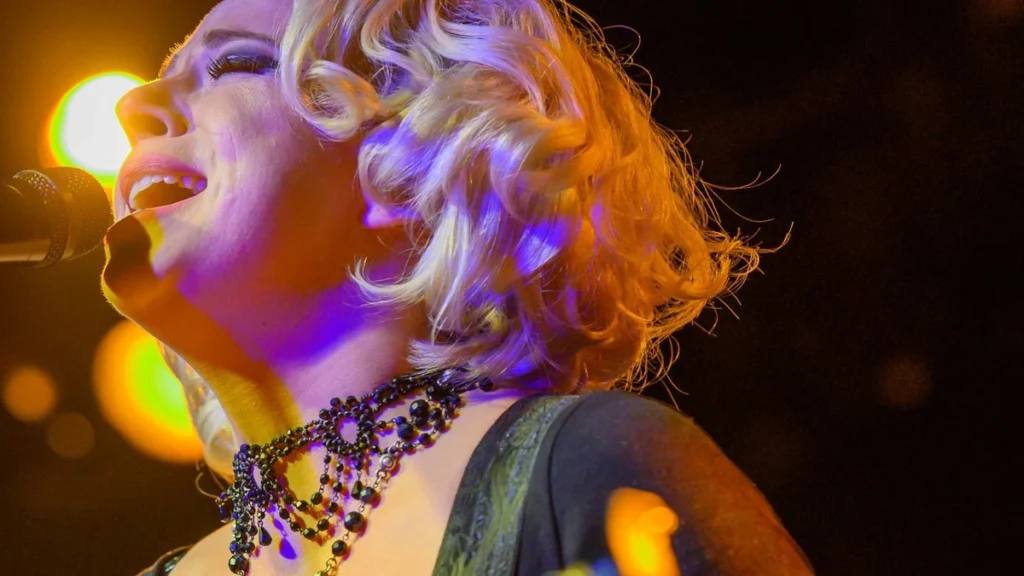
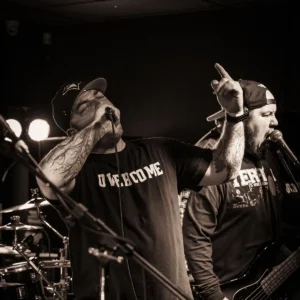
Samantha Fish performing in 2019.
Samantha Fish released the first official live album of her career in June, recorded at a theatre in Knoxville.
Her reputation has been built almost entirely on live performance.
A First Live Album This Late
The timing is the interesting part, since an artist known primarily as a live performer would conventionally have released one years ago.
Live albums were once close to obligatory, arriving after the second or third studio record as a way to document a band and fill a release schedule.
That convention collapsed when concert footage became universally available, and live albums became optional rather than expected.
Making one now is therefore a decision rather than a formality, which usually means there is a specific reason.
Recording in a Theatre
The album was cut at a restored theatre in downtown Knoxville rather than at an arena or a club.
Theatres are the best rooms for this purpose. They are acoustically designed, they hold enough people to generate atmosphere, and the audience is seated and therefore quiet between songs.
A club recording captures energy and bar noise in roughly equal measure; an arena recording captures reverberation. A theatre is the compromise that actually works.
Gospel Singers on a Blues Record
The McCrary Sisters appear on backing vocals, which brings a Nashville gospel tradition onto a blues-rock record.
That combination is historically obvious and practically rare, since the two forms share an origin and have almost entirely separate working circuits.
Adding a trio of trained gospel voices to a guitar-led band changes the arrangements fundamentally, because the vocals stop being decoration and start carrying weight.
What Backing Vocals Actually Do
The function is frequently misunderstood as thickening a chorus.
In a gospel-derived arrangement the voices are a second instrument, answering the lead line rather than doubling it, which changes the shape of a song rather than its density.
It also creates a live problem: those parts cannot be reproduced by a four-piece band, which is why they usually appear on records and disappear on tour.
The Album Behind It
The studio record it draws from was nominated for best contemporary blues album at the 68th ceremony.
It did not win, and the category went to another artist whose first win arrived after six previous nominations.
It was also named the year’s best album by at least one specialist publication, which in a genre this size is a meaningful piece of standing.
Why Live Albums Are Difficult
The format has a poor reputation for reasons that are mostly technical.
A concert works through volume, physical presence and the sense of being in a room with several hundred other people, none of which survives to a recording.
What is left is the arrangement, which is frequently a slightly rougher version of a record the listener already owns.
What Makes One Work
The successful examples share a characteristic: the live versions are meaningfully different from the studio ones.
That happens when songs have changed across a year of touring, when the live band is a different configuration from the recording session, or when guests are present who were not on the record.
All three apply here, which is the strongest available argument for the release existing at all.
An American Blues Artist in Europe
The touring runs through Germany, Italy, Switzerland, France and Finland alongside American dates.
European audiences have supported American blues musicians more consistently than American ones for the better part of sixty years, which is a well-documented and slightly uncomfortable fact about the genre.
For a working blues artist, a European leg is frequently the more reliable half of the year.
Touring With a British Trio
The dates carry a British power trio as support, which is a small piece of transatlantic symmetry.
The blues reached Britain through records, was rebuilt there as loud guitar music, and returned to America as rock, which is the single most consequential exchange in the genre’s history.
Sixty years later a British trio opening for an American blues guitarist is that exchange still running.
An Eighth Time in New Orleans
She has now appeared eight times at the New Orleans jazz and heritage festival.
Repeat bookings at a festival of that stature indicate something different from a single appearance, since programmers only return to acts that performed well.
It also connects her to a city whose musical infrastructure has shaped a substantial part of her work.
A Label With a Roots Catalogue
The album came out through Rounder Records, a label built on American roots music across several decades.
Labels of that kind operate on a different model from major imprints, with smaller advances, longer artist relationships and catalogues that earn steadily rather than spiking.
For an artist whose income is primarily live, that arrangement is frequently better than a larger deal.
Guitar-Led Blues in the Present
The genre occupies an odd commercial position: minimal radio, modest streaming, and a live business that supports a substantial number of touring musicians.
Its audience buys tickets repeatedly and buys physical media at shows, which is close to the opposite of how most contemporary music is consumed.
That produces careers with low ceilings and unusually solid floors, sustained by touring rather than by releases.
Playing Slide and Cigar Box
Her playing draws on slide technique and includes instruments outside the standard guitar family.
Slide is a specific discipline: the intonation is entirely in the hand, with no frets to correct a misplaced note, and it is unforgiving in a way conventional fretting is not.
It is also the technique most directly inherited from the earliest recorded blues, which is why it carries so much weight in this music.
Why a Live Album Is a Statement About the Band
The decision to record a concert is frequently less about the songs than about the players.
A touring band that has been together for a year or more develops an interplay that a studio session assembled from hired musicians cannot match, and it exists nowhere on the studio records.
Documenting it is the only way that version of the group survives, since touring bands change personnel and the specific combination is temporary by nature.
That is the strongest reason to make one, and it is almost never the reason given in the press release, which tends to talk about the songs.
The Gospel and Blues Split
Putting gospel singers on a blues record touches a division that ran through American music for most of the twentieth century.
The two forms share harmonic language, vocal technique and frequently the same performers, and they were kept rigidly separate by congregations who regarded secular performance as a betrayal.
Musicians who crossed the line were routinely condemned for it, and several of the most important figures in American song spent careers negotiating that split in public.
A record that simply puts both on the same stage without comment is possible now in a way it was not for most of the history of either form, which is worth noticing even when nobody remarks on it.
What Is Actually Being Tested
Two things. Whether a first live album, released this far into a career, documents something the studio records missed or simply repeats them louder.
And whether an arrangement built around gospel voices survives onto a tour where those singers are not present.
One theatre in Knoxville, one gospel trio, a first live album, and a European leg that pays the better half of the year.
About The Author



More Stories
The Sound of Burlington Rock-Blues: Off the Tracks by Brian Leduke
Matt Springfield: Poplife and Its Greg Haver Sessions, Reconsidered
How FYDStar Got Scream’s Cosmic Sludge Pop Out of a Bass and Drums Duo