



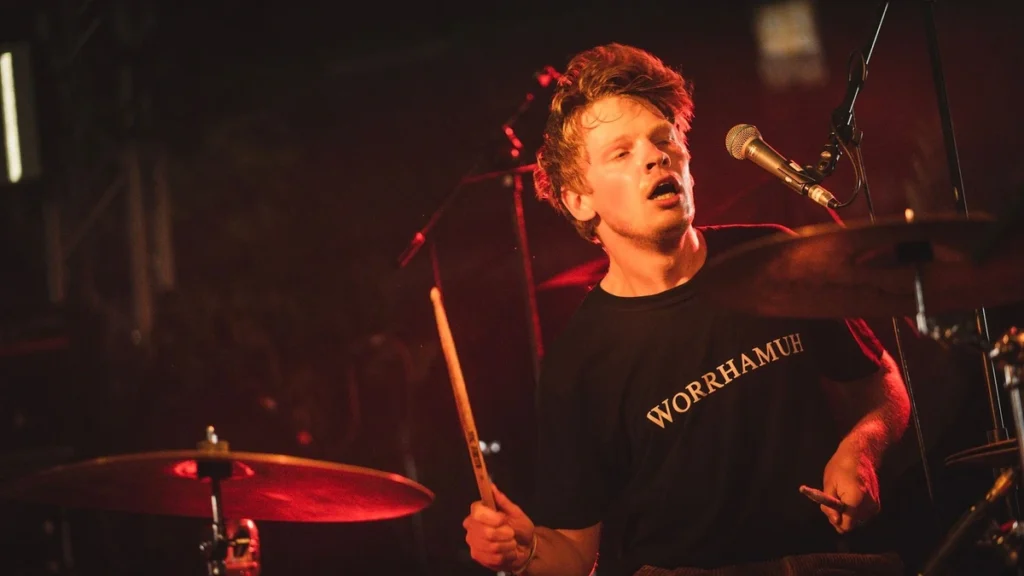
Squid performing live.
Squid go back to the city they formed in this October, for a festival held there each autumn.
They live in Bristol now, and they have three albums on an electronic label behind them.
Returning to the City They Left
The band came out of Brighton and relocated to Bristol, which is a common enough move and a slightly unusual direction.
Brighton has a genuine music economy, a large student population and a dense venue circuit, and it has produced a substantial number of guitar bands over three decades.
What it does not have is affordable space, and that is usually what moves a band. Bristol offers cheaper rehearsal rooms, cheaper rent and a scene with its own history, which for five musicians trying to keep a band viable is the deciding factor.
Going back for a festival is therefore not a homecoming in the sentimental sense so much as a return to a market that already knows them.
A Festival Built Across a City
Mutations runs across multiple venues in Brighton rather than on a field, which is a different proposition from a conventional festival.
Multi-venue city festivals use existing rooms, which means no infrastructure to build, no camping and no weather risk, and it means the sound in each room is the sound that room normally has.
They also let a bill be genuinely varied, since a two-hundred-capacity basement and a fifteen-hundred-capacity hall can sit on the same weekend without either looking odd.
The Drummer Sings
The band’s most distinctive structural feature is that the lead vocal comes from behind the drum kit.
That is rare for a reason. Singing while drumming requires holding two independent rhythmic patterns at once, and it removes the frontman entirely, which changes what a live show can look like.
What it produces musically is worth more than it costs visually. A vocal delivered by the person setting the tempo sits inside the rhythm rather than on top of it, and the phrasing follows the drums in a way a separate singer’s never quite does.
Vocals That Are Not Really Singing
The delivery is closer to speech, shouting and repetition than to melodic singing, which places it in a specific lineage.
Spoken and half-sung vocals have been a post-punk convention since the late 1970s, and the current British wave has made it close to a default.
The advantage is that words carry. The risk is that a whole scene ends up sounding alike, and the bands that survive it are the ones doing something distinct underneath the voice.
On an Electronic Label
All three albums have come out through Warp, which is not where a guitar band would obviously sign.
The label built its reputation on electronic and experimental music through the 1990s, and its roster has historically been closer to abstract dance music than to anything with a drummer.
Signing a band there is a positioning decision that tells you what the label heard: not a rock group, but a project interested in texture, structure and production, which is the tradition the imprint actually represents.
Songs That Run Past Eight Minutes
The records include pieces well beyond conventional song length, and that is the clearest evidence of what the band actually is.
A piece of that duration cannot survive on a verse and a chorus. It has to move through distinct sections, change tempo or metre, and arrive somewhere different from where it started.
That is progressive construction in the literal sense: composition rather than arrangement, with the piece treated as a structure to be built rather than a song to be performed.
Brass, Strings and Keyboards
The instrumentation extends well past two guitars, bass and drums, and it is used compositionally rather than decoratively.
Brass appears as a section with its own lines rather than as a horn stab, keyboards carry harmonic material the guitars are not playing, and strings show up where an arrangement needs a colour the band cannot produce.
Expanding the palette that way is the older progressive method, and it is what separates a band writing arrangements from a band writing songs and then adding parts to them.
Time Signatures That Move
The rhythmic writing shifts rather than staying in one metre, which is audible even when it is not obvious.
Changing metre inside a piece creates a sense of the ground moving, and it is difficult to do without the music sounding like an exercise.
What keeps it from becoming one here is that the changes serve the shape of the piece rather than demonstrating capability, which is the distinction between progressive writing and technical display.
Three Albums in Five Years
The catalogue now runs to three records, released across roughly five years.
That is a steady rate for a band at this level, where an album needs a touring cycle behind it and a year of writing before it.
Three records is also the point at which a band’s direction becomes legible. A debut can be a scene document and a second album can be a reaction to it, but by the third the choices are clearly deliberate.
The British Post-Punk Wave
They emerged alongside a substantial cohort of British bands working in adjacent territory, and the grouping has been useful and reductive in roughly equal measure.
Being part of a recognised wave gets a band written about, booked and heard far faster than it would be alone, which is a real advantage early on.
The cost arrives later, when the label sticks and every subsequent record is reviewed against a scene rather than on its own terms.
What a Third Album Has to Do
By a third record the initial attention has been spent and the audience is either committed or gone.
What a band needs at that point is not a bigger version of the debut but evidence that there is a direction, which is what stops an audience treating them as a moment.
Bands who manage it tend to have long careers on modest numbers. Bands who do not tend to have three good years.
Why a City Festival Suits This Band
The format matters more than it looks for a group working this way, and the reasons are practical.
A field festival gives a mid-bill band forty-five minutes in daylight through a system built for headliners, with an audience that is partly passing through. Long pieces do not survive that. The sections that need quiet get lost, and a piece that takes four minutes to arrive has lost the crowd before it does.
An indoor city festival gives a band a proper room with its own sound, a door that closes, and an audience that chose that room over three others happening at the same time. Everyone present made a decision to be there.
For music built on dynamics and duration, that is close to the difference between the show working and not working, and it is why bands of this kind take multi-venue festivals seriously while treating the summer circuit as income.
What a Guitar Band Gains From an Electronic Label
The label relationship shapes the records more than a signing usually does, and it is worth setting out how.
A rock label’s instinct with a band like this is to find the single, shorten the pieces and push the vocal forward, because that is the route to radio and radio is what that infrastructure is built for.
An electronic label has no such route. Its artists have never depended on radio, so the pressure to produce a three-minute version does not exist, and long-form, texturally strange records are the normal output rather than an indulgence to be argued for.
What the band gets is permission to write eight-minute pieces without that being a negotiation. What it gives up is the promotional machinery aimed at guitar audiences, which is a real loss and evidently an acceptable one.
What Is Actually Being Tested
Two things. Whether a band identified with a scene can keep writing past the point where the scene stops being interesting to write about.
And whether music built on long structures and shifting metre holds a festival audience in a room it did not book specifically to be in.
Three albums, one electronic label, a drummer who sings, and a return in October to the city they left.
About The Author


More Stories
The Sound of Burlington Rock-Blues: Off the Tracks by Brian Leduke
Matt Springfield: Poplife and Its Greg Haver Sessions, Reconsidered
How FYDStar Got Scream’s Cosmic Sludge Pop Out of a Bass and Drums Duo