




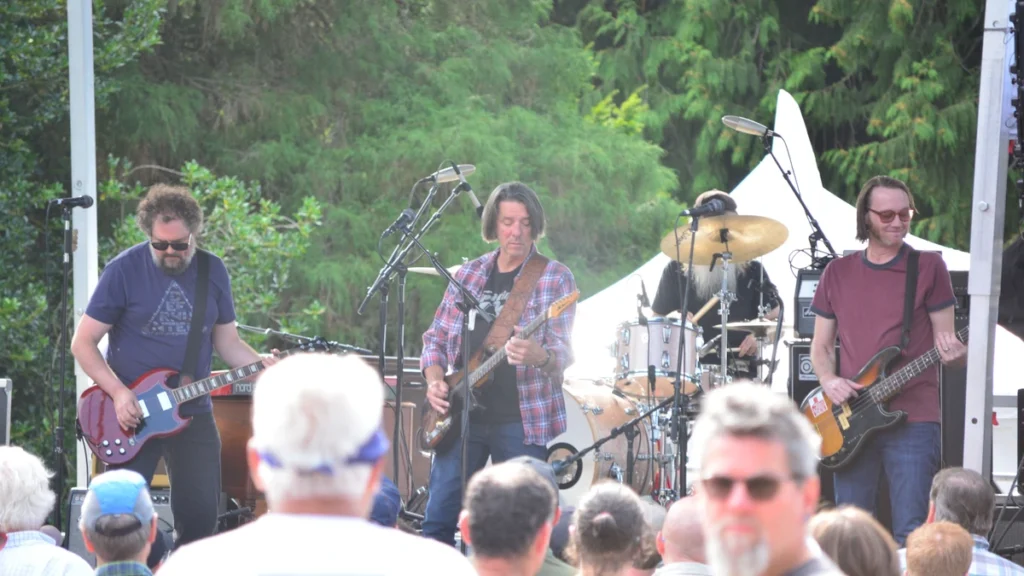
Drive-By Truckers performing outdoors.
Drive-By Truckers spent four nights in February playing the town they formed in, as they do most years.
They also played with a former member for the first time in around twenty years.
An Annual Residency in One Town
The homecoming run is a fixture rather than a tour date, held in Athens, Georgia across several consecutive nights each winter.
Multi-night residencies in a band’s home town are a specific institution, and they work on a different basis from touring. The audience travels to the band rather than the reverse, and a substantial share attend more than one night.
That changes what the shows can be. A four-night run has to produce four different sets, which for a band with fourteen albums is possible and for most bands is not.
It also converts a concert into an annual gathering, which is a considerably more durable thing to own than a tour.
Why Athens Specifically
The town has an outsized place in American music for a place of its size, having produced several bands that shaped college radio and alternative rock.
What made it work was a university, cheap rent and a small number of venues where everybody played, which is the same formula that has produced every functioning local scene.
A band returning there annually is doing something more pointed than nostalgia: it keeps money and attention in a small music economy that produced them.
Five Support Acts Across Four Nights
The residency carried five different opening acts, drawn from the same regional scene rather than from a booking agent’s roster.
One of them includes a youth music programme, which is an unusual thing to put on a bill and a deliberate one.
Using a residency to platform local and younger acts is what separates a homecoming from a hometown show, and it is the part that has kept this particular event going for years.
A Reunion Twenty Years Late
The band also performed with Jason Isbell, who wrote and played on three of their albums before leaving in the mid-2000s.
Departures of that kind are rarely clean, and both parties went on to substantial separate careers, which usually makes a reunion less likely rather than more.
Twenty years is long enough that whatever caused the split has stopped being the most interesting thing about it, which is generally the precondition for these things happening at all.
What He Wrote While He Was There
His contribution to the catalogue is disproportionate to the time he spent in the band.
Several of the songs from that period are among the most-played in the live set two decades later, and one album in particular is frequently cited as the band’s best.
That creates an odd situation for any group: material the audience loves most, written by somebody who left, played nightly by the people who stayed.
Three Songwriters at Once
The band’s defining structural feature was having multiple writers with distinct voices rather than one principal songwriter.
That produces records with genuine variety and it creates an obvious instability, since three writers eventually want three different careers.
Bands built this way tend to make their strongest work early and lose a member around the fourth or fifth album, which is close to exactly what happened here.
Songs That Are Actually Stories
The writing across this catalogue is narrative in a specific, unusual way.
The songs have characters with names, settings with geography, and events that happen in sequence, which is short-story construction applied to a three-verse form.
That is the Americana tradition rather than the rock one: the closest relatives are country and folk songwriting, where a song is expected to be about something that occurs rather than about a feeling.
Southern Subject Matter Without Nostalgia
The band writes about the American South directly, and the treatment is what distinguishes it.
Southern rock has a long tradition of regional pride that shades easily into something less examined, and a great deal of the genre never troubled itself about the difference.
These records take the region as a subject with a history attached, including the parts that are uncomfortable, which is why they sit in Americana coverage as often as in rock.
The Album That Named the Approach
An early double album built explicitly around the contradictions of southern identity is the record most people start with.
Concept albums about a region are a bad idea in almost every case, and this one worked because the songs are about individual people rather than about the thesis.
It also set the template the band has worked in since: specific characters, real places, and no resolution offered.
Fourteen Albums and a Reissue
The most recent studio record came out in 2022, and the band has been promoting a reissue of an earlier one alongside the touring.
Catalogue reissues are now a substantial part of how bands at this level earn, since the recordings are paid for and the audience buys physical copies.
Reissuing the album most associated with the departed member, in the same period as a reunion performance, is unlikely to be a coincidence.
A Band That Tours Constantly
The touring schedule has been close to continuous for twenty-five years, which is the actual basis of the career.
Radio never carried this music and streaming does not sustain it. What sustains it is several hundred people in a room, several hundred nights, accumulating across decades.
That is why the residency matters commercially as well as sentimentally: four nights at home is four nights the band does not have to drive between.
Why a Homecoming Residency Beats a Hometown Show
The economics of the format are worth setting out, because more bands could do this and do not.
A single hometown date sells to people who live there. A four-night residency sells to people who will travel, book a hotel and treat it as a weekend, which draws from a national audience rather than a local one.
The production is built once and used four times, there is no travel between shows, and the local venues, bars and hotels all benefit, which is why towns tend to be cooperative about it.
What it requires is a catalogue deep enough that four different sets are possible, and an audience committed enough to want all four. Very few bands have both, which is why the format stays rare despite being obviously advantageous.
What Twenty Years Does to a Reunion
One-off reunion performances have a poor reputation, and the reasons are usually structural rather than musical.
A band that reunites for a single appearance has rehearsed briefly, is playing material arranged for a different lineup, and is performing under the weight of an audience’s memory of how it used to sound.
What makes this case less risky is that the material never left the set. The songs have been played continuously for two decades by the people who wrote them alongside him, so the reunion adds a voice to an arrangement rather than reconstructing one from scratch.
That is the version of these things that tends to work, and it is a considerably lower bar than a full reformation, which nobody involved has proposed.
What Is Actually Being Tested
Two things. Whether an annual residency stays an event or slowly becomes a date on a calendar that people stop travelling for.
And whether a single reunion performance closes a twenty-year gap or reopens the question of what the band would sound like with that voice back in it.
Four nights, five support acts, one town in Georgia, and a guitarist who left before most of the audience was listening.
About The Author




More Stories
The Sound of Burlington Rock-Blues: Off the Tracks by Brian Leduke
Matt Springfield: Poplife and Its Greg Haver Sessions, Reconsidered
How FYDStar Got Scream’s Cosmic Sludge Pop Out of a Bass and Drums Duo