





The wider vinyl revival was a return. Here it was continuity.
The vinyl revival is usually told as a comeback story. In heavy music there was nothing to come back from.
You can listen to our full playlist which contains the artist’s music, and know more about the artist’s work by scrolling down the page.

PLAYLIST
There Was Nothing to Come Back From
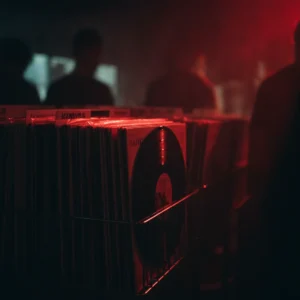
The vinyl revival is usually narrated as a comeback, with a format abandoned in the 1990s returning two decades later. In heavy music that story does not apply, because the format never went away.
Metal and hard rock labels continued pressing vinyl throughout the period when the wider industry treated it as obsolete, and a network of specialist labels, distributors and shops kept operating on the assumption that their audience wanted records.
What looked like a revival elsewhere was, here, simply the rest of the market arriving at a position the genre had held continuously.
Collecting Was Already Part of the Culture
The reason the format persisted is that the audience’s relationship with recordings was collection-oriented rather than consumption-oriented from early on.
Owning the object mattered, and owning a particular pressing mattered more. Limited editions, coloured variants, picture discs and regional pressings had established value in the scene long before the wider market rediscovered them.
That created a durable market for physical product that was not dependent on vinyl being the most convenient way to hear music, because convenience was never why these buyers were purchasing records.
Mail-order was the infrastructure that made this work before the internet, and the habits it built persisted. Buying unheard from a catalogue description required trust in the label, which is precisely the label loyalty that still sustains the format.

Artwork Is Not Incidental Here
Cover art occupies an unusually central position in heavy music, with recognisable artists, recurring imagery and a tradition of elaborate illustration that rewards being seen at scale.
A twelve-inch sleeve presents that artwork properly in a way a compact disc booklet does not and a streaming thumbnail certainly does not. For a genre where the visual identity is genuinely part of the work, the format is not nostalgic packaging.
Gatefolds, inserts, posters and lyric sheets extend this further, and they are standard rather than exceptional on heavy releases because the audience expects the record to be an object worth examining.
The Underground Economy Depended on It
There is also a practical history. Tape trading and small-run vinyl were the distribution system for extreme metal for years, operating largely outside conventional retail.
That infrastructure was built around physical objects moving between people, and the relationships and habits it created outlasted the technical necessity. Labels that grew out of it continued pressing records because that was what they did and what their customers wanted.
When digital distribution arrived, it was added alongside rather than replacing the physical operation, which is why so many of these labels survived a transition that eliminated comparable operations in other genres.
Limited coloured pressings function differently here than in pop. They are aimed at a collector base that will buy multiple variants of a record they already own, which is a smaller but far more reliable market than a chart-week strategy.

Streaming Did Not Displace It
The genre adopted streaming like everyone else, and the interesting result is that physical buying did not fall proportionally.
For many listeners the two serve different purposes: streaming for discovery and convenience, vinyl for the records they have decided to keep. Buying a record became an act of commitment to an album rather than the only way to hear it.
That division has proved stable, and it explains why heavy labels can still press meaningful quantities for acts whose streaming numbers are modest. The buyers are a subset of the listeners, and they behave very differently.
What the Rest of the Market Learned
The wider vinyl revival eventually arrived at a similar arrangement, with physical purchase as a deliberate act layered on top of streaming.
Heavy music got there first because its audience had never adopted the intervening assumption that recorded music was a stream of content rather than a collection of objects.
That is why the revival narrative fits so poorly here. The genre did not return to vinyl when it became fashionable; it maintained a market through the period when it was not, and that continuity is a large part of why the pressing infrastructure existed to supply everyone else’s revival.
Distribution never fully centralised either. Specialist mail-order distributors and label webstores still move a substantial share of the genre’s physical product, outside the retail chains that determine visibility elsewhere.













About The Author




More Stories
The Case Against Rock Being Dead
Why Metal Subgenres Multiply
The Bass Guitar Problem in Heavy Mixes