
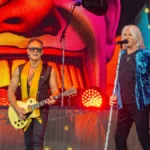

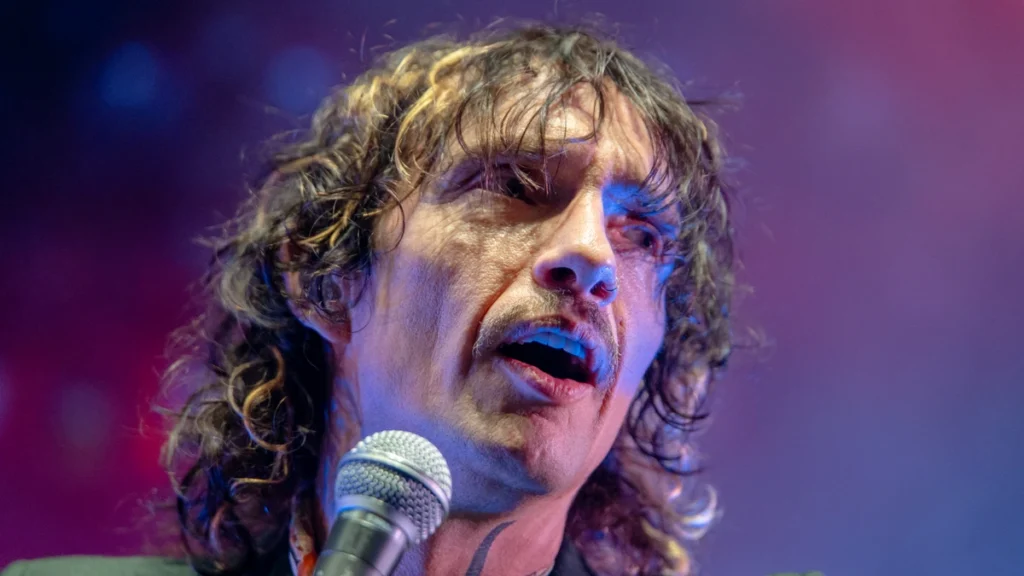
Justin Hawkins performing live
Moth Club has a small, glittering stage and started life in 1972 as a servicemen’s club. On 17 September a band that will be playing arenas by December is going to stand on it. The Darkness have announced a one-off in Hackney billed as Crock Of Hits, built around a best-of setlist they have chosen themselves.
Announcing it on Instagram, the band promised that Crock Of Hits “will startle you. Hold you as you tremble. And gently force you to succumb to its aural splendour,” which is about as on-brand a sentence as Justin Hawkins has ever committed to a press release. Presale opens at 10am on Tuesday 8 September, with general sale on Thursday 10 September, both through dice.fm.
What the Show Actually Is
A band-curated best-of is a different proposition from a warm-up gig. A warm-up runs the arena set in a small room to test it. This is the band choosing which of their own songs they want to play, in a venue where the front row is close enough to hear the unamplified guitar, which usually produces a very different list.
NME reported the details when the announcement landed. The show sits ahead of a UK arena tour behind 2025’s Dreams On Toast, which begins in December, so this is not a rehearsal for that run so much as a separate event with its own logic.
December touring is a habit for this band rather than an accident. Dan Hawkins has put it plainly: “We’re just part of people’s festive period, and we’ve got quite a few Christmas songs.” Few acts have engineered a seasonal residency out of a back catalogue this deliberately, and the arena run is the commercial expression of it.
The Venue Has Spent Two Years Defending Itself
The choice of room is not neutral. Moth Club’s future has been in question since two planning applications were submitted to Hackney Council for flats on Morning Lane, directly next to the venue. The operators argued that residents living that close would generate noise complaints and, in time, restrict the club’s ability to put on shows at all.
The response was one of the largest campaigns a grassroots venue has mounted in Britain. By December 2025 the council had received more than 27,000 emails of objection, and the petition supporting the venue passed 34,000 signatures. The Music Venue Trust argued that losing Moth Club would represent an existential threat to grassroots venues generally, on the grounds that if this one could not be defended, few could.
On 25 March the council refused the first application. NME reported that the official refusal found the proposal “fails to demonstrate that the new residential use would not result in unreasonable restrictions being placed on the MOTH Club”, contrary to both the London Plan and the National Planning Policy Framework. It was also refused on affordable housing, provision for disabled residents, and the possibility of archaeological remains on the site.
Why the Refusal Matters Beyond One Venue
The legal principle underneath this is Agent of Change, which puts the burden of soundproofing on the developer building next to an existing venue rather than on the venue that was there first. It is a sound principle and it is routinely tested by applications that assume a small music room will simply lose.
What makes the Moth Club refusal useful is that the council wrote the reasoning down in exactly those terms. A refusal that says a development failed to show it would not restrict an existing venue is a citable precedent, and it is worth considerably more to the next venue in the same position than a sympathetic press cycle would be.
The fight is not finished. A second, adjoining application is still awaiting a decision, and the venue’s programmer Keith Miller has said the club is “not fully out of the woods yet”. The Hackney Citizen reported his view that a second refusal would produce, in his words, the greatest party Moth has ever witnessed.
The Room Has Better Form Than Its Size Suggests
Established in 1972 and reopened as a music and comedy venue in 2015, Moth Club has hosted a run of acts far larger than its capacity would predict. Lady Gaga, Dave Grohl, Everything But the Girl and Caroline Polachek have all played on that glittering stage, which is the practical argument for why the building matters.
That list is also the answer to anyone who treats a room this size as a rounding error. Rooms this size are where an act finds out whether the songs work before anyone has committed to a tour, and they are where established acts go when they want a night that cannot be replicated in a shed. Both functions disappear if the room does.
For a band at The Darkness’s level the calculation is straightforward. They will sell every ticket in minutes, make almost nothing on the night, and put a venue under threat in front of an audience that will read about it. That is a more effective intervention than a statement.
Who Fought the Application, and How
The campaign was not run by the venue alone, and the structure of it is the part worth copying. Moth Club’s events programmer Keith Miller credited the outcome to work by the venue alongside the Music Venue Trust, the Night Time Industries Association and the campaign group Save Our Scene, which spearheaded the letter-writing effort that produced the volume of correspondence the council received.
That combination matters because the three organisations do different jobs. The Music Venue Trust makes the sector-wide argument about what losing a room costs. The Night Time Industries Association carries the commercial and licensing case. Save Our Scene mobilises the audience. A venue on its own has one voice; a venue with all three has a policy argument, a business argument and thirty-four thousand signatures.
The support also came from well outside Hackney. Musicians, labels, festivals, agencies and cultural institutions across the UK and beyond backed the objection, which is what turned a local planning matter into a national one. Councils weigh correspondence, and a planning committee reading tens of thousands of objections is looking at a materially different file from one reading forty.
Miller’s own summary of the refusal, shared when it came through, was straightforward: the planning application next door had been refused, and it was the result of a great deal of work from the venue, the supporting organisations and the people who signed. The lesson for the next venue in this position is that the machinery already exists and can be called on.
Where This Sits in the Band’s Year
The Darkness have had an unusually visible run. Dreams On Toast arrived in 2025, the arena dates follow in December, and the band spent the summer on large stages including a support slot at Knebworth Park in July. A Hackney club show in the middle of that is a deliberate change of register.
Dan Hawkins has been candid about how the audience was rebuilt after the band reformed: “When we got back together, we had to really develop a hardcore fanbase again.” A best-of set in a small room is aimed squarely at that fanbase, and it is the sort of show that only makes sense once the hardcore audience exists.
RockRevival.News has covered the same tension elsewhere in heritage rock, as when Deep Purple made their 24th album without their producer writing it: a long-running band deciding what it still wants to be, rather than repeating the version that sold.
What to Watch on 17 September
The interesting thing is the setlist. A band-curated best-of from a group with one famously enormous single and four decades of material is a chance to see which songs they rate rather than which ones a promoter would insist on. That gap is usually wider than an audience expects.
The second thing is whether the night is used to talk about the venue’s position. It would be strange to book a room in this situation and say nothing, and the campaign’s own experience is that visibility is what moved the numbers from a local objection to 34,000 signatures.
Tickets will be gone quickly, and the presale on 8 September is where the show will be decided rather than the general sale two days later. For anyone outside London, the December arena run is the accessible version. It will be a bigger production and a considerably less interesting room.
About The Author


More Stories
Swiss Dialect Rock, Reconsidered Through Zueri by Dave Curl
How Bite To Break Got the Weight of Slam and Death Metal Onto In My Head
The Bowie Cover Def Leppard Played Before Every Show Is Now a Single